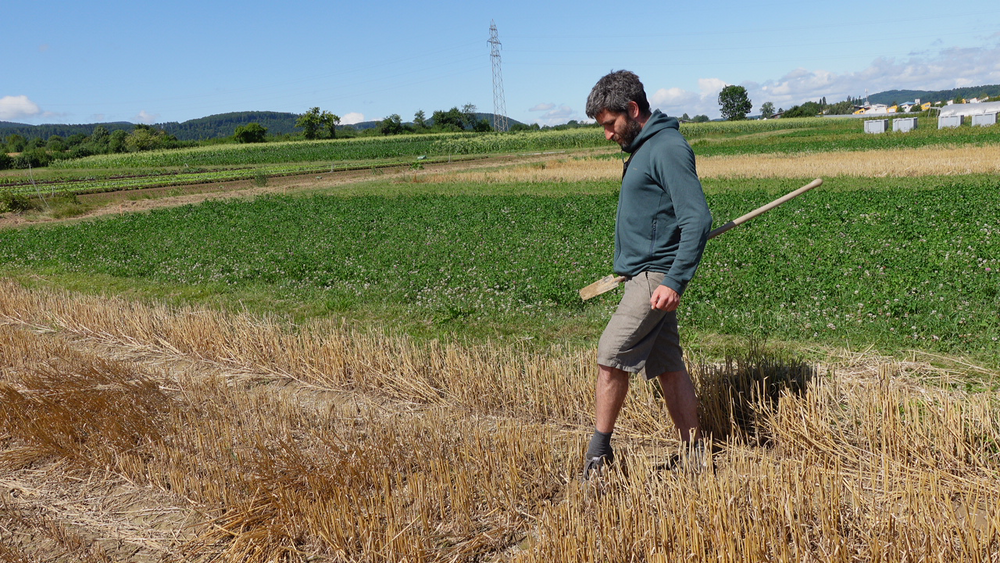
The DOK field trial has been running in Therwil, Switzerland, for 45 years – and is providing answers that are crucial for the future of agriculture. In an interview with Lukas Maschek, trial manager Hans-Martin Krause explains why patience is essential in agricultural research, how biodynamic agriculture is reversing the global trend of declining soil fertility, and why living soils are the best insurance against climate stress.
Lukas Maschek:The DOK field trial is regarded worldwide as one of the most important long-term studies on organic farming. What distinguishes it from other research projects?
Hans-Martin Krause: What makes it special is its history: the trial was not initiated by authorities or universities in the 1970s, but by farmers themselves. It was a bottom-up movement. The initiators wanted to know how different farming methods affect the soil, yield and ecosystem in the long term. That is why we have been comparing biodynamic, organic and conventional cultivation plots ever since – with an unfertilised and a mineral fertilised control group.
You talk about ‘long term’. How long did it take for the first differences to become apparent?
Much longer than many people might think. It took 22 years of observation before significant differences in the organic carbon content of the soil could be detected with the same fertilisation intensity. This is an impressive example of how slowly soil systems respond to different agricultural practices and how important patience is in agricultural research. Short-term studies would never have revealed these effects.
What is the most significant result that emerged from the comparison of the three cultivation methods?
The most impressive finding is that the biodynamic method, in which we use manure and compost, shows a clear increase in the carbon content of the soil, i.e. an increase in soil fertility. Globally, we are seeing the opposite trend: arable soils are losing fertility and thus quality over the years. The fact that we can reverse this trend through targeted agricultural practices is encouraging – not only for Switzerland, but for global agriculture.
How does biodynamic practice affect soil quality?
Soil quality cannot be reduced to a single value. Organic activity is the decisive factor. In biodynamic plots, we measure the highest microbial biomass, the highest organic carbon content and greater biodiversity – from soil microbes to the number and diversity of insects. Such active soils are more resistant to stress and ensure long-term stable production.
Conventional systems are generally more productive. How do you assess the tension between yield and ecological quality?
It is a classic conflict of objectives. Conventional systems deliver higher yields in the short term and are economically attractive for many farms. Ecological systems, on the other hand, offer clear advantages in terms of soil quality, biodiversity and climate protection – the latter because they cause lower soil-bound greenhouse gas emissions. The big challenge in the coming years will be to reward these ecological services financially. If they generate income for farmers, there will be a real incentive for more sustainable farming.
What does this mean in concrete terms for political decisions?
We need instruments that reward benefits for the ecosystem. This is already happening in Switzerland, for example when a farmer converts to IP, organic or Demeter. Payments for proven increases in soil fertility or for the promotion of certain species might be considered. Only if such benefits are reflected in the business model can we implement more ecological food production on a broad basis.
How do you assess the significance of the DOK trial for the future? What are the upcoming questions?
Adaptation to climate change is one of the most pressing issues. We are already seeing significantly more extreme years: 2023 was exceptionally dry, while 2024 was very wet. These extremes put pressure on all farming systems. Our data from the coming decades will show which farming methods are best able to cope with such fluctuations. Initial indications suggest that organic systems – thanks to higher organic matter and better soil structure – can store water for longer and are better able to withstand at least moderate heat waves.
A diverse soil microbiome acts as a buffer. It stabilises the nutrient cycle, improves water storage and promotes resilience to disease. We cannot artificially replace this ‘organic insurance’. That is why maintaining a living soil is one of the most important strategies against climate stress.
What are your personal wishes for the future of agriculture?
If we manage to combine ecological and economic goals, we can make agriculture climate-proof and future-proof.
Interview in the latest issue of our magazine Living Farms