Farmyard manure improves soil properties in long-term experiment
The biodynamic method is the oldest certified way of practising organic agriculture. Despite a growing number of studies on the effects of biodynamic practices, how biodynamic compost preparations work remains scientifically unclear and is still debated among experts. In a study from 2022, a team of researchers led by Heberto Rodas-Gaitan investigated the effects of biodynamically prepared compost on several soil parameters. The measurements took place on a long-term trial site in Germany that has been in operation since 1993. The measurement of multi-substrate-induced respiration is one method used to assess microbial soil communities. The researchers hypothesised that the fingerprint of the soil microorganisms could distinguish the three farmyard manure treatments.
Farmyard manure (FYM) in the form of composted livestock manure is more than just fertiliser. It improves overall soil quality, increases soil organic carbon (SOC), reduces erosion, improves the water balance and contributes to climate protection. In addition, farmyard manure is locally available and cheap to produce. In biodynamic agriculture, six preparations are added to the farmyard manure in small doses. The preparations are made from yarrow, chamomile, nettle, oak bark, dandelion and valerian.
Soil microorganisms are an important indicator of soil health and performance. Healthy soil, in turn, supports both animal and plant health. One way to measure soil health is by measuring multi-substrate induced respiration (multi-SIR). Put simply, this method offers the soil microorganisms various organic substances and checks whether and how quickly the substances are converted or respired. Multi-SIR can therefore be used to create a fingerprint of the microbial soil community.
For the present study, four different treatments were investigated, each with six replicates:
1. control trial without farmyard manure
2. farmyard manure only
3. farmyard manure with yarrow preparation
4. farmyard manure with all six compost preparations
The test plots are located in Hennef, Germany, and have been part of a long-term trial since 1993. Apart from the four treatments, identical farming practices are used on all test plots.
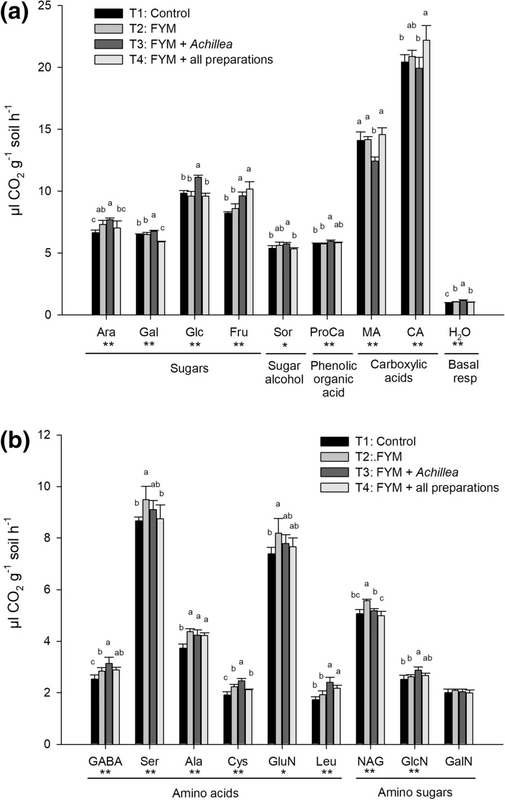
Figure 1: Results of the multi-SIR analyses. Metabolic reactions of soil microorganisms to different substances. T1: Control experiment without farmyard manure. T2: farmyard manure only. T3: Farmyard manure with yarrow preparation. T4: Farmyard manure with all six compost preparations. Different letters above the bars indicate significant differences from the other treatments. Upper graph (a): Ara (L-arabinose), Gal (D-galactose), Glc (D-glucose), Fru (D-fructose), Sor (sugar alcohol sorbitol), ProCa (phenolic organic and protocatechuic acid), MA (malic acid), CA (citric acid), H2O (distilled water). Lower graph (b): GABA (y-aminobutyric acid), Ser (L-serine), Ala (L-alanine), Cys (L-cysteine), GluN (L-glutamine), Leu (L-leucine), NAG (N-acetyl-glucosamine), GlcN (D-glucosamine), GalN (D-galactosamine).
Compared to the control plots, adding farmyard manure increased the availability of the primary nutrients (nitrogen, phosphorus and potassium), the SOC content and the microbial biomass in the soil on all plots. The compost preparations did not significantly affect these chemical and microbial soil parameters. However, a difference was measured in terms of the Multi-SIR. For this parameter, treatment 3 (farmyard manure with yarrow preparation) showed the highest microbial respiration, followed by treatment 4 (farmyard manure with all six compost preparations), treatment 2 (farmyard manure only) and treatment 1 (control trial without farmyard manure). In addition, treatments 3 and 4 could be distinguished based on the multi-SIR data. Treatment 3 in particular showed a positive influence on the nitrogen balance of the soil microorganisms. The reason for the better performance of the yarrow preparation compared to the application of all six preparations could not be explained within the framework of this study.
Comment
This study observed an effect of the biodynamic preparations on farmyard manure. However, significant differences were only measured for some observed parameters. In comparison, the positive impact of farmyard manure – compared to the control plots without adding farmyard manure – is much clearer, evident in many parameters, and is largely undisputed. The principle of action of the biodynamic preparations has still not been fully deciphered. The ongoing discussion within the scientific community includes various theories, such as a biochemical stimulation of the micro-organisms or increased mindfulness and care on the part of the farmer. However, with the help of the currently available scientific methods, it has not yet been possible to attribute the observed effects precisely. The present study supports previous efforts but highlights the need for further research.
Details of the original research paper
- Authors: Rodas-Gaitan, H., Fritz, J., Dahn, C., Köpke, U., Joergensen, R. G.
- Title: Biodynamic compost effects on soil parameters in a 27-year long-term field experiment
- Journal: Chemical and Biological Technologies in Agriculture 9, Article number: 74 (2022)
- Link: https://doi.org/10.1186/s40538-022-00344-w