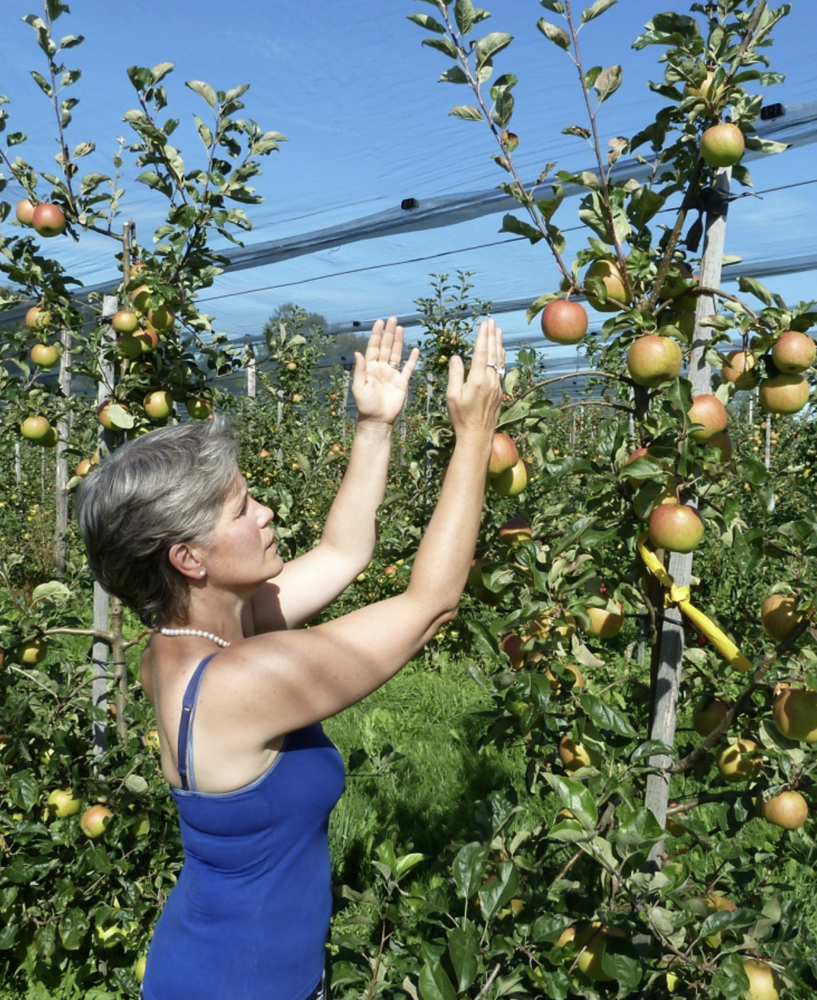
Perhaps you have already experienced eurythmy on stage or in a Waldorf school? Or as a form of therapy for illnesses? The ArteNova Institute has been investigating another application for 25 years: how eurythmy gestures affect plants. Many years of research show that eurythmy not only influences the growth of seedlings, but also the taste of apples.
Eurythmy was developed as a movement art by Rudolf Steiner. The sounds of the alphabet correspond to the etheric forces. If one could speak all the sounds at the same time, this would correspond to the human etheric body. Each eurythmy gesture is like a focus on a specific etheric force: the B focuses on a centre; it is an envelope and protection like our skin. The L flows, rises and sinks like the water cycle, an archetype for our blood circulation. Thus we find the archetypal forces of plant growth in the eurythmy gestures. With eurythmy treatments, we want to enter into a dialogue with plants on the etheric level.
Pioneering research
In 2000, eurythmist Tanja Baumgartner began researching the effect of eurythmy on plants. First, she spent almost ten years working with Stephan Baumgartner from the Hiscia Institute to investigate the basics: duration and frequency of treatment, distance from the seed or plant during treatment, influence of the person performing the treatment, influence of the phases of the moon, and more. In 2007, the ‘ArteNova Institute for Eurythmy in Research and Art’ was founded to provide an institutional framework for the research work. Since then, over 80 different research projects have been carried out. Since 2012, the focus has shifted to the targeted application of eurythmy: how can certain effects be achieved that are desired in agricultural, horticultural or breeding work? This expanded the spectrum of eurythmy treatments to include water, soil, animals and food.
The influence of treatment duration
The number 40 has a special meaning in the Bible, which is why we wanted to investigate this period as a treatment duration. Tanja Baumgartner treated water with the sounds L and W over the following periods: one day, seven days and forty days. We then germinated cress seeds in two repetitions with this water.
After the treatment, the longitudinal growth was measured and the water was examined using formative forces research. In terms of the total length of the seedlings, the W plants were significantly longer than the L plants after one day of treatment. After seven days, the effect was reversed: the L plants were significantly longer than the W plants – a result that was consistent with our previous experience. There were no differences between the plants treated for 40 days and the untreated control plants.
The influence of the moon phases
Due to striking results in previous experiments, we investigated the interaction between eurythmy treatments and the phases of the moon. To this end, water was treated by four people using different gestures and then given to cress seeds on three new moon and three full moon dates, and the longitudinal growth was examined again. It was found that in all three repetitions, the sprouts were significantly longer at new moon than at full moon. In the interaction of the moon phases with the individual sound gestures, the effect was that at new moon the effect of the sounds could not be distinguished, while at full moon there were clear differences between the sounds.
We can therefore assume that the forces of the moon interact subtly with the etheric forces, which should be taken into account when using biodynamic preparations or potentised remedies, for example.
Water as a storage and transmission medium
In terms of the practical application of eurythmy treatments, we investigated the extent to which water is suitable as a medium – i.e. as a means of storage and transmission. To this end, water was examined, using eight test methods, for differences after eurythmy treatments with five different sounds and a variant with ‘non-eurythmy movement’. The investigations ranged from the physical level, for example with UV spectroscopy, via tests on living organisms (cress and algae tests) and picture-forming methods, to formative forces research.
Differences in the water were found in seven of the eight methods. In particular, a grouping of sounds with similar results became apparent. When the results of the individual tests were sorted according to their value, two groups emerged: one with W, B and ‘movement’ and one with K, S and L. These groups were also identified in the research into formative forces.
From the results, we conclude that the changes brought about by the eurythmy treatments can be demonstrated at various levels. Groups of sound gestures showed a comparable effect in this water experiment.
Sweet and crisp apples
One of the questions we were asked from the field was whether apples can become sweeter and crisper through eurythmy treatments. To this end, Tanja Baumgartner treated apple trees seven times for ten minutes at a time from blossom to harvest. Initial tests in the laboratory of the Research Institute of Organic Agriculture (FiBL) already showed an increase in sugar content in apples that were treated with the aim of increasing sweetness.
In a follow-up experiment, we then had two treated varieties tested in a blind taste test in a taste laboratory. Here, too, the treatment resulted in an increase in sweetness. Above all, however, the value in the ‘overall assessment’ parameter was significantly higher for the treated variant of both varieties than for the untreated ones. This shows that eurythmy treatments can influence the quality of food. This offers great potential for biodynamic agriculture!
Tanja Baumgartner is the founder of the ArteNova Research Institute and a eurythmy therapist.
Eckart Grundmann studied agricultural sciences at the University of Kassel-Witzenhausen and conducts research at the ArteNova Institute.
Read more articles on biodynamic research in the new issue of Living Farms magazine