Humans are the only living beings on Earth that cook their food. No animal is capable of using heat or fire in such a way as to create something new – a cooked meal. That is why everyone should learn to cook. At the hob, you learn how to handle fire and heat, and you can be creative – whether you’re preparing a vegetable terrine or baking an apple cake. By using herbs and spices, you create flavours that stimulate the senses and appeal to the palate.
Cooking is a culture. We do not merely consume fresh vegetables or fruit straight from the field; rather, these natural foods are altered and transformed through cooking and preparation. In some cases, cooking is what makes them edible in the first place, as with the potato, which is indigestible when raw. In this way, cooking brings about a new creation. That is why it is also referred to as an art. Who doesn’t think of a delicately seasoned meal, lovingly prepared and served? It’s enough to make your mouth water. Giving free rein to creativity, enjoying experimentation and making something yourself. That is art, when an idea finds expression in the substance of the earth.
Indeed, our humanity is nurtured through food culture. Care is evident in the presentation of dishes, for example in a salad decorated with flowers. A sense of beauty is evoked by the table decorations and the design of the dining room. Sharing a meal provides a place for people to come together and experience joy and pleasure.
Working with food appeals to many of our senses: we see, touch, smell and taste. These sensory experiences are important for our relationship with the world. We also gain a tangible sense of the food’s origins. When we know where a salad comes from and how much work goes into it before it is ready to eat in the bowl, it takes on a value that cannot be expressed by its price alone. We treat it with greater awareness and care.
In the school kitchen, children and young people learn through hands-on experience. In the process, they gain fundamental insights that they can later understand better in the classroom. When egg white becomes firm and white when heated, they experience first-hand what is later referred to in chemistry lessons as the denaturation of proteins. When bread turns brown in the oven, they can later understand the Maillard reaction. In this way, connections are formed between everyday experiences and scientific knowledge.
Through hands-on activities in the kitchen, children and young people also develop a positive relationship with nutrition and food. Cooking is practical, achievable and enjoyable. Cooking and eating together foster enjoyment, a sense of community and appreciation.
Isn’t this one of the best ways to give children a positive approach to food – and thereby make an important contribution to the prevention of eating disorders?
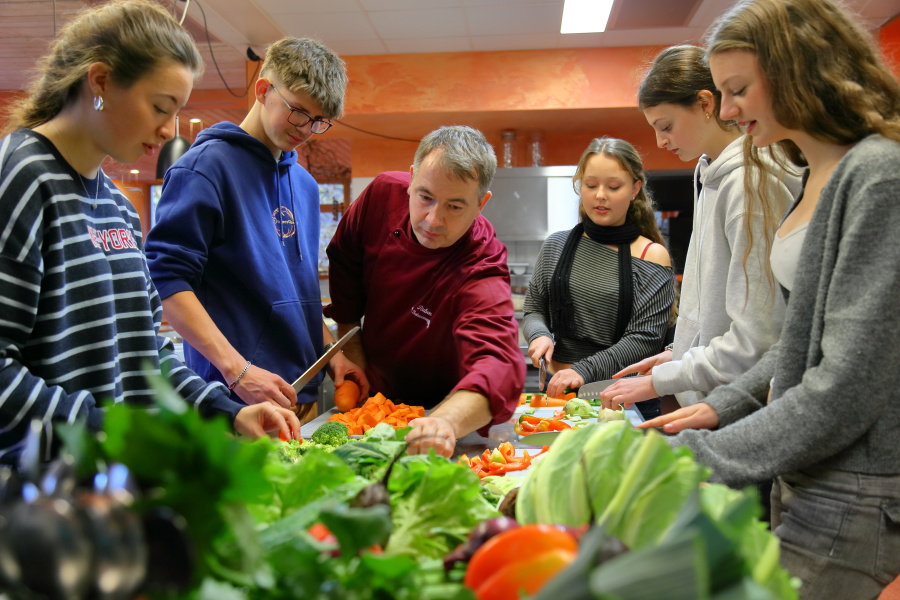
Ruben von Schwanenflügel demonstrates how this can be put into practice in the school kitchen with his ‘Küche BILDET’ concept.
Dr Jasmin Peschke is a nutritionist and heads the Nutrition Department at the Section for Agriculture at the Goetheanum, Switzerland.
‘Küche BILDET’ – the school kitchen as a place of learning
Ruben von Schwanenflügel
A while ago, I made pizza for 120 people with two pupils. We calculated and weighed out the ingredients for 25 kilograms of dough, kneaded the dough, spread it out onto lots of baking trays and topped it. Later, the two of them sat amongst their friends and ate the pizza they’d spent the whole morning making. They saw the trays being emptied and the result of their efforts. The meaning lies in the whole context: using grain and other ingredients, a meal is created with one’s own hands; it is needed and enjoyed, provides for other people and brings them together around a table. This context makes the school kitchen a place of learning.
I have been in charge of the kitchen at the Windrather Talschule school in Velbert, Germany, since 2005. Together with my team, I prepare around 300 breakfasts and 250 lunches every day. Four children and young people from Years 7 to 10 help out daily with the day-to-day running of the kitchen. In all these years, lunch has never been ready late because the children were helping to cook – quite the opposite!
A real task changes the way learning takes place; this becomes clear when one or two Year 7 pupils cook 250 portions of pudding. They have usually never prepared such a large quantity before. The pudding doesn’t burn, has no lumps and is spooned into little bowls without spilling everywhere. At lunchtime, 250 people eat it, and you can see just how proud the pupils are. That morning, the task still seemed daunting; a few hours later, they’d managed it.
The real changes don’t happen in a single morning. They develop over the years, through recurring kitchen days, familiar routines and regular practice. Over time, their movements become more confident. The children prepare their workstations more independently, recognise the procedures and increasingly see what needs to be done next. Individual experiences gradually turn into habits; here, skill emerges visibly from the act of doing. Anyone who has chopped a few kilograms of vegetables will hold the knife differently at the end than they did at the start. Anyone who works with dough develops a feel for its consistency over time. Quantities, sequences, cleanliness and time lose their abstract nature; they determine whether the meal turns out well.
As confidence grows, attitudes towards one’s own work often change too. A child who was hesitant at first later points to a bowl of soup and says: ‘I made that.’ At lunchtime, they see others helping themselves to it. Perhaps a friend praises the soup or helps themselves to a second helping. The feedback is immediate and relates to something that has actually been created. This is where self-efficacy manifests itself very tangibly. The child experiences that their own actions have a visible consequence. They have achieved something that holds value for other people. The pride they feel is not an educational bonus; it arises from the work itself.
Cooperation also develops through the shared task. With 25 kilograms of pizza dough, the individual steps depend on one another. Whilst one baking tray is being topped, dough is already being rolled out or vegetables prepared elsewhere. The pupils coordinate their efforts, pass on information and respond to one another. Teamwork is demonstrated less through an explanation than in the moment when two people work on the same dough and achieve a shared result.
As their practical skills develop, so too does their confidence in their own abilities. Parents tell me that, after a day in the kitchen, their child suddenly starts preparing something on their own at home or carries out a task with a confidence they’ve never seen before. I can only observe in the kitchen to what extent individual skills transfer to other areas. The fundamental experience, however, is clear: at first I couldn’t do something, I did it, now I can do it better, and I can apply this to other tasks as well.
In everyday kitchen life, children’s perspective on food often changes. A carrot is washed, peeled, chopped, cooked and later eaten. The children experience its texture, smell and taste in different states. As a result, food appears less like a finished product; its origin and processing become understandable. At our school, we use almost exclusively organic and biodynamic food. Most of it comes from local farms that the children get to know. There, they experience how vegetables grow, the importance of the seasons, and the many steps involved between sowing the seeds and sitting down to lunch. In this way, organic and local production become tangible; they are evident in the soil, in the plant, in the harvest and, finally, on the plate. Health is an integral part of this context. Daily meals accompany the children throughout their school day. A varied breakfast and lunch nourish the body and give the day a rhythm. In my experience, learning comes more easily when hunger, sharp fluctuations in energy levels or an unbalanced diet can be avoided.
Healthy habits are formed through repetition. With us, the children encounter vegetables, salads, wholemeal products and a variety of ways of preparing them every day. They choose for themselves at the buffet. Nobody is pressured into trying anything, yet the selection remains consistently visible and accessible. Taste is individual and changes over time. What may seem unfamiliar at first becomes more familiar through repeated exposure. Parents repeatedly tell us that, at home, their children naturally reach for foods they recognise from school. For me, this is a key benefit of practical nutrition education: healthy eating is not merely about knowing which foods are right or wrong. It becomes part of their lived everyday experience and, as such, a part of their life.
The whole process comes together in the dining hall. Regional produce is processed in the kitchen, prepared by children and adults, and is now eaten together. The children see the people for whom they did the work that morning. At the same time, those eating know who was involved in preparing their lunch. Former pupil Sarah describes this experience as follows: ‘The fact that lunch is prepared in the community by oneself or by people one knows is so much more than just a meal! It’s community, joy and life!’ Isabel recalls ‘how important eating together is for a community and how lovely it is to prepare it for everyone’. Thea sums it up in four words: ‘Food brings people together.’
‘Küche BILDET’ grew out of these experiences. The practical form this takes may vary from school to school, as spaces, processes and people differ. There are now many tried-and-tested ways of involving children and young people in preparing food and developing the kitchen as a place of learning. The aim here is to learn for life and lay the foundations for one’s own health.
By the end, the lunch has all been eaten. For many children, this leaves them with a very tangible experience: I’ve done something that was of value to other people.
Ruben von Schwanenflügel is a chef, kitchen manager and consultant for school and community kitchens, as well as for organisational development. Since 2005, he has been in charge of the kitchen at the Windrather Talschule, a Waldorf school in Velbert, Germany. Together with Heidi Leonhard, he founded the ‘Küche BILDET’ initiative (https://www.küchebildet.de/).