• News
  • Événements
    • Événements
    • Offres en ligne
    • Congrès d' Agriculture
    • Goetheanum.tv
    •  
    • Événements passés
    •  
    • Événements externes
  • Domaines de travail
    • Département d’Alimentation
    • Conseil biodynamique
    • Formation
    • Recherche
    • Sustainable Development
    • Agroforestry
    • Cercle économique
    • Préparations
    • Living Farms
    • Semences
    • Animal husbandry
    • Cours aux agriculteurs
    • Thème de l'année
    • Groupes professionnels
    • Viticulture biodynamique
    • Arboriculture fruitière
    • Plantes médicinales et aromatiques
    • Aménagement Paysager
    • Abeilles
    • Oléiculture
  • Publications
    • Livres
    • Podcast
    • Magazine
    • Documentation du Congrès
    • Rapport d’activités
    • Circulaire
    • Plus d'informations
    • Agriculture biodynamique
  • À propos de nous
    • Contact
    • Team
    • Vision et mission
    • Partners / Networks
    • Plus d'informations
    • Presse / Communiqués de presse
    • The Glashaus (Glasshouse)
    • Newsletter
    • Soutenir la Section
  • Recherche
  • DE EN FR ES

Recherche plein texte

 
  1. Section d'Agriculture
  2. News

News

Orchards: Sustainable approaches for healthier soils

Créé par Lukas Maschek | 29/10/2024 |   Research

What impact do different agricultural practices have on soil life in orchards in the long term? A team of researchers led by Aissa Arous investigated this question by studying commercial orchards in southern Italy. The aim of their research was to evaluate the effects of sustainable practices compared to conventional methods on microbial biomass activity and functional diversity in the soil.

Soil microorganisms play a crucial role in maintaining soil fertility. Sustainable soil management aims to maintain soil functions by minimising disturbance and enhancing them through the use of organic matter. This allows agricultural systems to function more effectively while increasing crop yields and reducing negative environmental impacts.

For this study, six mediterranean orchards in southern Italy were analysed, each of which has been managed either conventionally, organically or biodynamically for more than 15 years. The results show that organic and biodynamic practices lead to a higher soil organic carbon (SOC) content. In these soils, the microbiological activity and diversity of microbial communities is also increased, with the highest values in biodynamically grown plums and organically grown peaches. The lowest values were measured in conventionally farmed apricots.
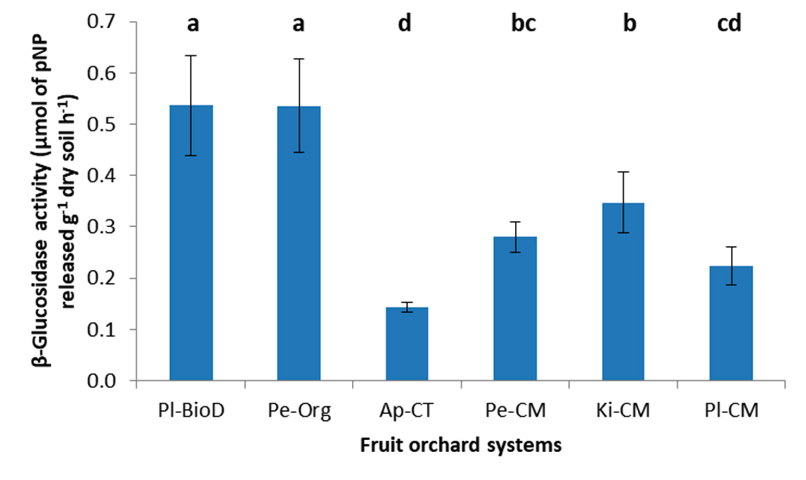
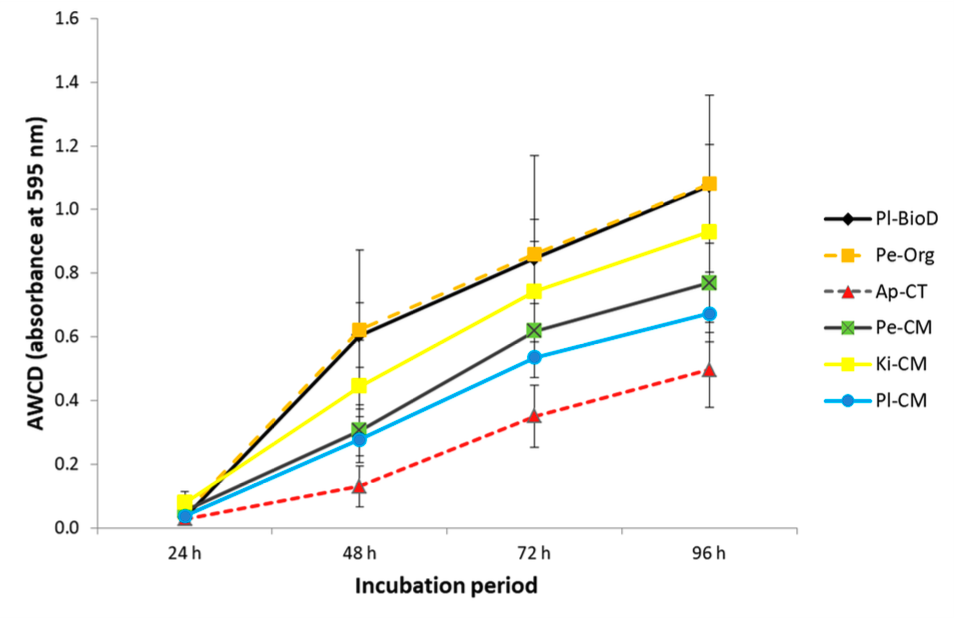
Figure 1: β-glucosidase activity in the individual orchards. β-glucosidase is used together with other factors as an indicator of biological soil activity. Different letters indicate statistically significant differences. Pl-BioD: Plum Biodynamic, Pe-Org: Peach Organic, Ap-CT: Apricot Conventional Tillage, Pe-CM: Peach Conventional, Ki-CM: Kiwi Conventional, Pl-CM: Plum Conventional.

Figure 2: AWCD (average well-colour development) captures the functional diversity of the microbial communities in the soil. Pl-BioD: Plum Biodynamic, Pe-Org: Peach Organic, Ap-CT: Apricot Conventional Ploughed, Pe-CM: Peach Conventional, Ki-CM: Kiwi Conventional, Pl-CM: Plum Conventional.

The study authors state that the combination of different conservation soil management strategies increases the positive effects on microbiological indicators compared to the application of individual measures. The longer the sustainable methods are practised, the stronger the results.

Which measures are suitable for maintaining soil and plant health in the long term?

  • Avoiding soil-disturbing practices such as frequent ploughing and chemical weed control
  • Avoid bare, unvegetated soils
  • Purposeful underplanting, e.g. for nitrogen fixation or to increase organic biomass
  • Promotion of useful companion plants through selective mechanical weed control at the right time
  • Use of farm compost that is as diverse as possible

All these practices are in line with the principles of biodynamic agriculture to promote long-term soil fertility. As the data was collected on commercial orchards rather than test plots, the methods used to maintain soil health can be considered feasible. However, the data set of the study is relatively small, with six orchards and two soil types. Further research is therefore required to confirm the observed results. However, it appears that biodynamic practices can not only improve soil structure, but also make a positive contribution to long-term soil fertility and resilience to environmental influences.


Sources and further links to this article

  • Original study:
    Arous, A., Gargouri, K., Palese, A. M., Pane, C., Scotti, R., Zaccardelli, M., Altieri, G., Celano, G. Microbiological Soil Quality Indicators Associated with Long-Term Agronomical Management of Mediterranean Fruit Orchards. Agriculture 2024, 14, 1527. https://doi.org/10.3390/agriculture14091527
  • The study is covered by Creative Commons (link to licence) and has been summarised for this study report.

Section d'Agriculture

Goetheanum
Hügelweg 59
4143 Dornach/Suisse
+41 61 706 42 12
agriculturenoSpam@goetheanum.ch

Goetheanum

  • Goetheanum

Événements

  • Événements
  • Offres en ligne
  • Congrès d' Agriculture
  • Goetheanum.tv
  • Événements passés
  • Événements externes

News

  • News

Publications

  • Livres
  • Podcast
  • Magazine
  • Documentation du Congrès
  • Rapport d’activités
  • Circulaire
  • Agriculture biodynamique

À propos de nous

  • Contact
  • Team
  • Vision et mission
  • Partners / Networks
  • Presse / Communiqués de presse
  • The Glashaus (Glasshouse)
  • Newsletter
  • Soutenir la Section

Domaines de travail

  • Département d’Alimentation
  • Conseil biodynamique
  • Formation
  • Recherche
  • Sustainable Development
  • Agroforestry
  • Cercle économique
  • Préparations
  • Living Farms
  • Semences
  • Animal husbandry
  • Cours aux agriculteurs
  • Thème de l'année
  • Viticulture biodynamique
  • Arboriculture fruitière
  • Plantes médicinales et aromatiques
  • Aménagement Paysager
  • Abeilles
  • Oléiculture

© Copyright 2026 Société anthroposophique universelle. Alle Rechte vorbehalten.

Empreinte

Empreinte

Allgemeine Anthroposophische Gesellschaft

Rüttiweg 45
4143 Dornach/Schweiz
Tel. +41 61 706 42 42
Fax +41 61 706 43 14
sekretariatnoSpam@goetheanum.ch
UID: CHE-103.601.774

Webmaster
webmasternoSpam@goetheanum.ch

Conception, conception et mise en œuvre technique ainsi que support et hébergement
PIXELPETER GmbH
Rüttiweg 56
4143 Dornach/Schweiz
www.pixelpeter.ch