• News
  • Événements
    • Événements
    • Offres en ligne
    • Congrès d' Agriculture
    • Goetheanum.tv
    •  
    • Événements passés
    •  
    • Événements externes
  • Domaines de travail
    • Département d’Alimentation
    • Conseil biodynamique
    • Formation
    • Recherche
    • Sustainable Development
    • Agroforestry
    • Cercle économique
    • Préparations
    • Living Farms
    • Semences
    • Animal husbandry
    • Cours aux agriculteurs
    • Thème de l'année
    • Groupes professionnels
    • Viticulture biodynamique
    • Arboriculture fruitière
    • Plantes médicinales et aromatiques
    • Aménagement Paysager
    • Abeilles
    • Oléiculture
  • Publications
    • Livres
    • Podcast
    • Magazine
    • Documentation du Congrès
    • Rapport d’activités
    • Circulaire
    • Plus d'informations
    • Agriculture biodynamique
  • À propos de nous
    • Contact
    • Team
    • Vision et mission
    • Partners / Networks
    • Plus d'informations
    • Presse / Communiqués de presse
    • The Glashaus (Glasshouse)
    • Newsletter
    • Soutenir la Section
  • Recherche
  • DE EN FR ES

Recherche plein texte

 
Accueil Recherche Rapports d'études Projets Repère Research Conference BDRC
  1. Section d'Agriculture
  2. Domaines de travail
  3. Recherche

Silica in viticulture strengthens the vine and increases wine quality

Créé par Lukas Maschek | 12/11/2024 |   Research

How does silicon affect the growth of grapevines and the quality of the grapes? An Australian research team led by Cassandra Collins is investigating this question. In their current study from 2024, the researchers are investigating how the application of biodynamic and commercial silica-based products affects various parameters of the vines and grapes. In addition to the analytical examination of the grapes, a blind tasting was also carried out.


Silicon is not a macronutrient in plant cultivation, but it nevertheless fulfils important physiological functions. It strengthens plants' resistance to disease and stress, promotes growth, and has a positive effect on fruit characteristics. In biodynamic agriculture, silicon is particularly well known as the main component of preparation 501.

The results of the present study show that the application of silicon has a positive effect on the vines studied. Both the commercially available potassium silicate and the biodynamic spray preparation BD501 led to stronger cell walls compared to the control group, making the treated vines more resistant to environmental stress. In addition, qualitative improvements were observed in the grapes in terms of their aromas and the flavour of the wine.

The researchers conclude that silicon could play a key role in plant health, for example in terms of reducing the need for synthetic pesticides and fertilisers. The research results suggest that silica-based treatments

  • can naturally enhance plant health,
  • supports the resilience of vines to abiotic stress,
  • promotes soil quality.

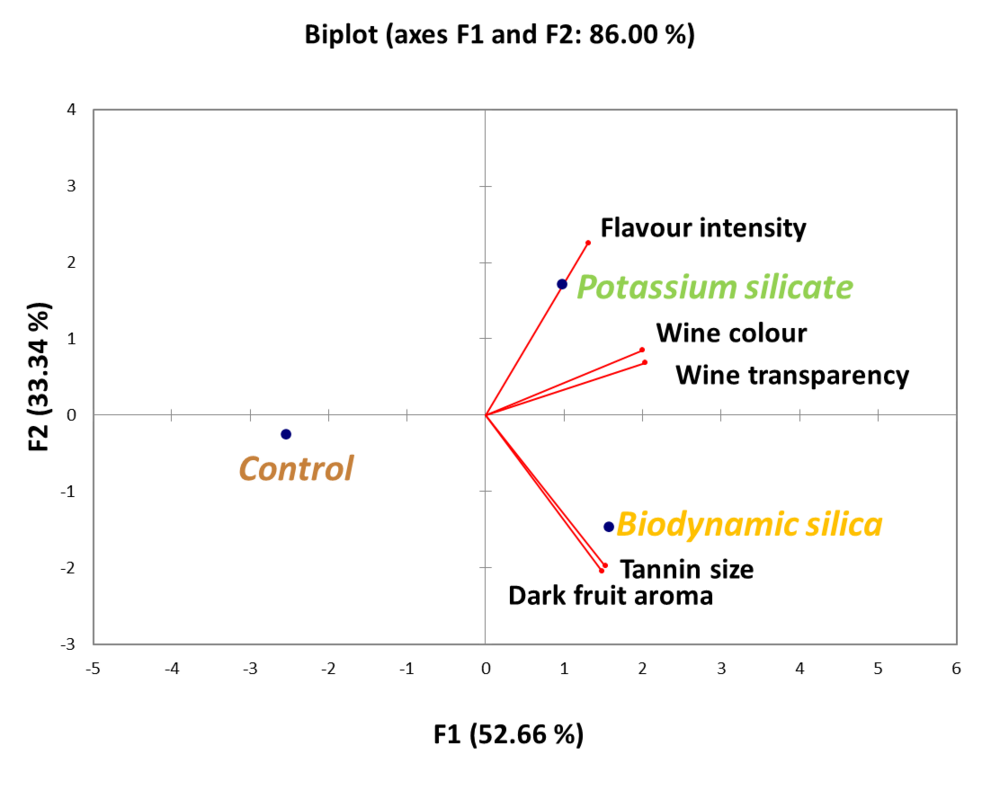
Figure 1: Graphic representation of the sensory evaluation of the grapes. Different samples are marked by dots, flavour characteristics are represented by arrows. Longer arrows indicate a stronger link.

In a blind tasting, the sensory evaluation of the grapes by a specifically trained panel showed clear differences between the various treatments. The application of silicon influenced, among other things, the perception of the fruit sugar content and the fruit flavour. Astringency was also increased by the addition of silicon, indicating a change in tannin composition and structure.

The study's conclusions are in line with the aims of biodynamic cultivation, which favours natural cycles and the strengthening of plants rather than intensive chemical interventions. The researchers found that potassium silicate had a more significant positive effect on the vines and grapes than the biodynamic preparation 501, although this is contextualised by the fact that preparation 501 has a significantly lower silicon concentration than potassium silicate.


Sources and further links to this article

  • Original study:
    Collins, C., Bloomfield, S., Hansen, L., Gilliham, M. Can silica application enhance vine performance and quality? OENO One, 58(4). 2024. https://doi.org/10.20870/oeno-one.2024.58.4.8192
  • This study is covered by Creative Commons (link to license) and has been summarized for this study report.
Retour

Section d'Agriculture

Goetheanum
Hügelweg 59
4143 Dornach/Suisse
+41 61 706 42 12
agriculturenoSpam@goetheanum.ch

Goetheanum

  • Goetheanum

Événements

  • Événements
  • Offres en ligne
  • Congrès d' Agriculture
  • Goetheanum.tv
  • Événements passés
  • Événements externes

News

  • News

Publications

  • Livres
  • Podcast
  • Magazine
  • Documentation du Congrès
  • Rapport d’activités
  • Circulaire
  • Agriculture biodynamique

À propos de nous

  • Contact
  • Team
  • Vision et mission
  • Partners / Networks
  • Presse / Communiqués de presse
  • The Glashaus (Glasshouse)
  • Newsletter
  • Soutenir la Section

Domaines de travail

  • Département d’Alimentation
  • Conseil biodynamique
  • Formation
  • Recherche
  • Sustainable Development
  • Agroforestry
  • Cercle économique
  • Préparations
  • Living Farms
  • Semences
  • Animal husbandry
  • Cours aux agriculteurs
  • Thème de l'année
  • Viticulture biodynamique
  • Arboriculture fruitière
  • Plantes médicinales et aromatiques
  • Aménagement Paysager
  • Abeilles
  • Oléiculture

© Copyright 2026 Société anthroposophique universelle. Alle Rechte vorbehalten.

Empreinte

Empreinte

Allgemeine Anthroposophische Gesellschaft

Rüttiweg 45
4143 Dornach/Schweiz
Tel. +41 61 706 42 42
Fax +41 61 706 43 14
sekretariatnoSpam@goetheanum.ch
UID: CHE-103.601.774

Webmaster
webmasternoSpam@goetheanum.ch

Conception, conception et mise en œuvre technique ainsi que support et hébergement
PIXELPETER GmbH
Rüttiweg 56
4143 Dornach/Schweiz
www.pixelpeter.ch