In a 2020 research study, Hendgen et al. investigate the long-term effects of viticulture on physical and chemical soil parameters. They compared the three farming methods biodynamic, organic and integrated farming in a test field in Germany. Biodynamics performed well. But not only.
Copper and carbon: long-term effects in biodynamic viticulture
Creado por Lukas Maschek | | Research
This study was carried out in a vineyard in Geisenheim, which was planted with Riesling vines in 1991. Since 2006, the three cultivation systems biodynamic, organic and integrated have been tested on around 0.8 hectares in a block design with four replicates (similar to the DOK trial). Soil samples were taken under the vines, in the tractor track and between the rows.

Figure 1: Different sampling points for the soil samples.
The biodynamic plots have a lower soil density than the plots under integrated farming. In addition, significantly more organic carbon was found in the biodynamic samples than in the other two systems. The increased biodiversity of the cover crop mix in biodynamic management improves the soil structure, which in turn leads to an increase in water storage capacity and biological activity. These factors have a positive effect on soil health.
The soil samples from the biodynamically and organically farmed plots show a significantly increased copper concentration. This is due to the use of copper as a pesticide, as synthetic fungicides are prohibited in biodynamic and organic farming. Although the copper levels are within the legal limits, long-term copper accumulations in the soil could have a negative impact on soil fertility (more on copper in viticulture). Copper is a heavy metal that remains in the soil for a long time and is poorly degraded.
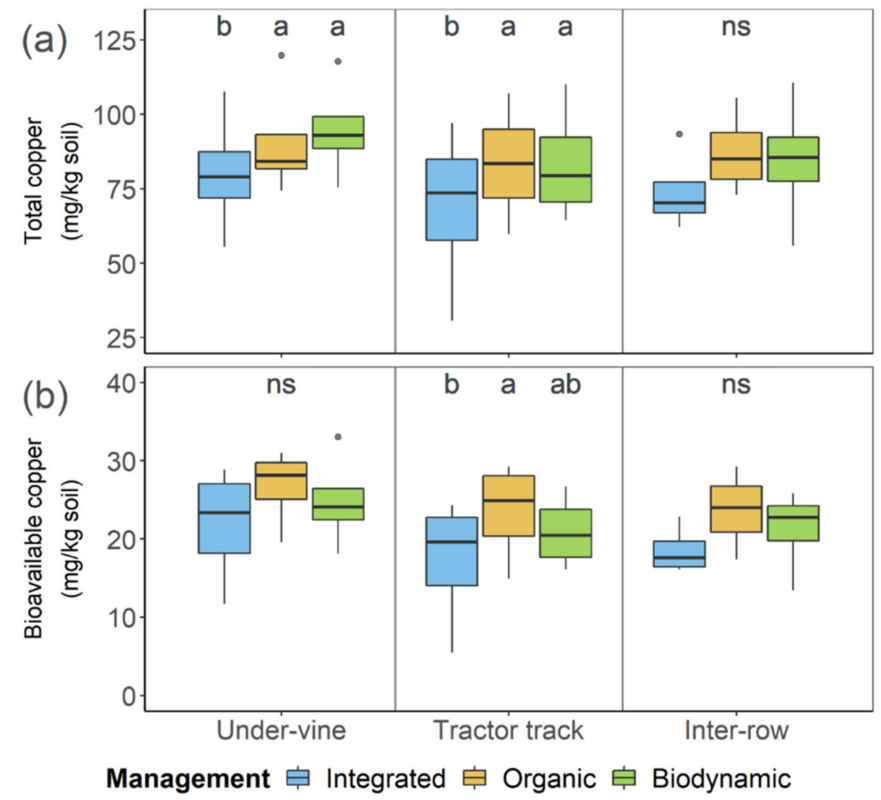
Figure 2: (a) Under the vines and in the tractor track, organic and biodynamic farming show significantly higher levels of total copper. (b) The results for bioavailable copper are less clear. Different letters indicate statistically significant differences. Ns: not significant.
Biodynamic farming showed positive effects on soil structure and organic carbon content compared to the other systems, indicating improved soil health. At the same time, copper accumulation represents a long-term risk. In order to make viticulture more sustainable, copper-free plant protection products must be sought and more robust grape varieties promoted.
Sources and further links to this article
- Original study: Hendgen, M., Döring, J., Stöhrer, V., Schulze, F., Lehnhart, R., Kauer, R. Spatial Differentiation of Physical and Chemical Soil Parameters under Integrated, Organic, and Biodynamic Viticulture. Plants 2020, 9, 1361. https://doi.org/10.3390/plants9101361
- Study report ‘What is the DOK trial?’
- Study report ‘Copper in viticulture - effective fungicide or problematic contaminant?’