A devastating flash flood swept away parts of the Himalayas, leaving a trail of destruction across Nepal. People were killed or injured, homes and infrastructure were destroyed, and many families lost their homes and livelihoods.
For Nepali journalist Narayan Wagle, the disaster is more than a natural event. It raises fundamental questions about how Nepal manages its natural resources – and what “progress” can mean in a world increasingly shaped by climate change.
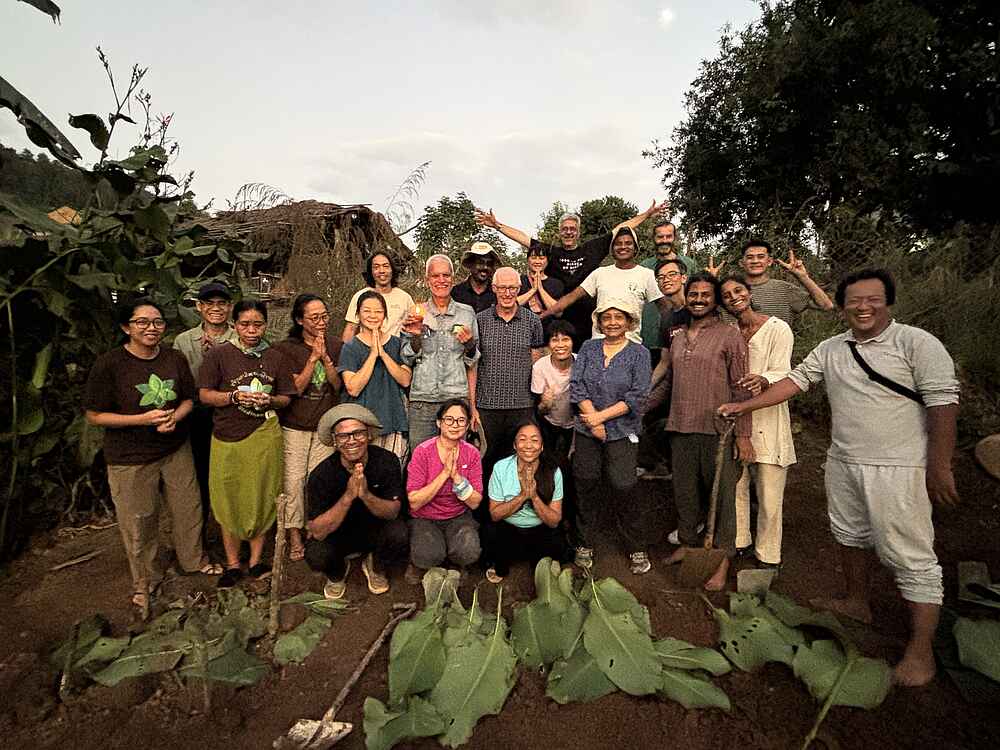
Those wishing to support the people affected can donate through reputable aid organizations providing emergency relief and reconstruction assistance in Nepal. To support the biodynamic community in Nepal, please feel free to contact:
Narayan Wagle palpasacafe@gmail.com
Krishna Gurung krishna@krmef.org
Namaste!
After more than three decades of a busy life in journalism in Kathmandu, I found myself back on my family farm in Tanahun, in the western countryside.
The return was not simply a change of place. It was a change of perspective.
Away from the urgency of the capital, I began spending more time with the soil, conducting workshops in biodynamic agriculture and permaculture, and reconnecting with the rhythms of farming and rural life. The longer I stayed, the more I found myself looking again at the country I had spent so many years observing and writing about.
I began to wonder whether I had been looking at Nepal too much through the lens of politics, economics and daily news—and not enough through the land itself.
From the farm, many things look different.
I began thinking more deeply about the mindset that has taken hold of our society: our growing appetite for what we call modernity, and the almost irresistible attraction of consumerism.
We have come to associate progress with more roads, more concrete, more vehicles, more buildings, more consumption and more extraction.
But the soil asks a different question. The river asks a different question. And the mountains ask a different question: What kind of life are we actually building?
Long ago, I collected a folk song called Bhaedako Un Jasto—“Like Sheep’s Wool”—from Langtang region and gave it to Nepathya, the rock-based band known for bringing folk traditions into contemporary Nepali music. For last two decades, they have carried the song with them wherever they perform.
It begins with an image of something falling from the sky:
What came falling from the sky,
like sheep’s wool?
I will take your picture,
like the full moon.
There is something almost innocent about the image: wool drifting down from the heavens, soft and white.
But the region where that song became popular has now witnessed something falling from the sky that was neither soft nor white.
It was brown. It was a torrent of ice, rock, mud and debris. And it was not really a flood from the river. It was a mountain coming down.
The Langtang Lirung glacier collapsed, sending an enormous mass of ice, rock and debris hurtling downstream at terrifying speed, sweeping away whatever stood in its path. A huge crash was followed by a tsunami-like surge that seemed to descend from the sky, racing through gorges and valleys and erasing everything beneath that mighty peak.
People had been warned. Some received frantic calls telling them that a flood was coming.
But even then, they did not run far enough. They had an idea of how high a flood could rise. They had lived with rivers all their lives. They knew floods. They had no frame of reference for this.
This was not an ordinary flood. It was something almost unimaginable—a Himalayan tsunami. And perhaps that is why its psychological impact has been so profound.
For centuries, the Himalaya has represented permanence in the Nepali imagination. The mountains were a sacred presence that appeared immovable: ancient, eternal, beyond the reach of ordinary human intervention.
Governments changed. Cities grew and decayed. Roads were built, political systems transformed and generations came and went.
The mountains remained.
Until they did not.
Most of Nepal’s mountain river valleys are ancient centres of settlement and civilisation. Generations of people cultivated their fields there, built homes beside streams and rivers, and learned to live with the seasonal rhythms of water.
Then came modernity.
Roads were carved along river corridors. Towns grew beside those roads. People moved down from the hills in search of schools, hospitals, markets, jobs and the other promises of development.
Slowly, the geography of Nepal became intertwined with the geography of aspiration—and ambition.
Roads run beside rivers. Settlements gather around roads. Towns and cities expand along river corridors. And for many Nepalis, even the dream of going abroad to earn money is ultimately connected to a piece of urban space—a small plot on which to build a house and secure a place for the family.
We have built our dreams into the landscape. Now the landscape is showing us how vulnerable those ambitions can be. The river that brought roads, access and development can become a force of destruction. The mountain that symbolized permanence can suddenly collapse.
Perhaps this is the deeper trauma of Langtang.
It is not only that homes, roads, bridges and landscapes have disappeared. Something more fundamental has been shaken: the image of the Himalaya as the one thing that could not be moved.
The mountain itself has entered our imagination as a source of unpredictability.
And yet, amid this devastation, another story has been unfolding.
The rescue operation continues, with people still searching for those trapped inside hydropower tunnels. In the first days, the images were almost unbearable: people swept away, bodies lying on deserted stretches of sand, desperate escapes and encounters between life and death.
Then, gradually, something changed. The stories began to turn. From destruction to courage. From loss to rescue. From mourning to waiting. From despair to hope.
A small girl, found amid the wreckage of her village, looked up at the policemen who came to rescue her. Her eyes were bright and full of life. Her photograph travelled through a grieving country. For a moment, the whole nation seemed to see itself in those eyes.
Life was still there.
Then came another extraordinary moment of relief. After ten days buried inside hydropower tunnels, workers were brought out alive. Ten days underground. Ten days during which the country did not know whether they would survive. And then, one by one, the lucky survivors emerged. The country breathed again.
These moments do not undo the disaster. They do not restore the homes, landscapes or lives that have been lost. They cannot return the old sense of permanence.
But they reveal another kind of permanence—one that belongs not to mountains, but to people. The Himalaya may be fragile. Human courage can be astonishingly resilient. People search. People dig. People wait. People refuse to give up.
And sometimes, beneath tonnes of earth and rock, life answers back. Perhaps healing begins there.
We have lived with floods for generations.
Every monsoon, farmers in the valleys have worked the land while keeping one eye on the sky. There is a rhythm to this uncertainty. The river rises. The river falls. The fields survive. Sometimes they do not.
My own relationship with rivers is deeply personal.
My brother and I were so accustomed to swimming in the Seti-Madi River that, one summer, our parents almost gave up hope three times when the waves rose and we did not reappear.
Each time, somehow, we came back. Eventually, my parents decided they had had enough.
They sold the riverside farmland and bought a plot near a spring. The farm I look after now is therefore safe from floods. Or at least it is safe from the floods I know.
Since Langtang, I have found myself looking differently at the hills around me and at the high mountains beyond them. What if the mountains themselves can perish? And if they can, what happens to the millions of people living downstream?
Perhaps the next great movement of Himalayan geography will not only be of rocks and rivers. It may also be a movement of people.
Last November, we hosted the Asian Biodynamic Conference in Nepal. Its theme was “Healing Himalayas.”
We could not have imagined that, within less than a year, we would ourselves be haunted by the Himalaya.
But perhaps this is the moment when the meaning of that phrase becomes clearer. To heal the Himalaya, we may first have to heal ourselves.
We need to ask difficult questions about what we mean when we say “development.”
How much construction can these mountains bear? How many roads, bridges, hydropower projects, towns and concrete structures can we continue to build along rivers and unstable slopes without fully understanding the risks?
Our hunger for hydropower is understandable. Electricity is one of our great hopes for economic development. We dream of exporting it and earning the foreign exchange needed to pay for the enormous volume of goods we import.
Tourism and electricity have become two of our principal economic hopes.But hope itself needs to be examined. What kind of development are we pursuing? And what are we willing to sacrifice for it?
Agriculture, meanwhile, was never given the priority it deserved in answering the deeper questions of our development. Somewhere along the way, we began to believe that living with farmland meant being poor, while leaving the soil and moving to the city meant progress. So people left the very land where they were born.
Even those who remained on the land have often seen their relationship with it transformed. Excessive chemical inputs and heavy machinery can reduce farming to a simple equation of production: more yield, more output, more efficiency.
But soil is not merely a medium of production. It is alive.
And agriculture is not merely about producing food. It is a relationship between people, land, water, animals, plants, climate and time.
The question is therefore not only whether agriculture can produce more. It is whether agriculture can once again become a source of life, dignity and resilience.
We need to restore farmers’ confidence in regenerative agriculture—not as a fashionable alternative, but as one possible foundation of survival in a changing climate.
And the principle of regeneration cannot stop at the farm. It has to enter every aspect of our lives.
Our cities, roads, bridges, banks, industries, schools, homes and public institutions all need to be reconsidered through the basic science of living within ecological limits.
Climate change is not simply an environmental issue. It is a question about how we build. How we eat. How we travel. How we produce. How we consume. How we govern.
Perhaps our deepest mistake was trying to develop Nepal like every other country in the world without first asking how profoundly different Nepal is.
We have a uniquely fragile mountain ecosystem. Extraordinary biological and cultural diversity is compressed into a relatively small territory. We have some of the highest mountains on Earth, deep river valleys and young, unstable geological formations.
And now we live in a rapidly changing climate and time. Yet our imagination of development has rarely begun with this reality.
We have asked: How can we build more?
Perhaps we should now ask: How can we live better while building less recklessly?
That requires a different idea of modernity.
Modernity cannot simply mean more roads, more concrete, more vehicles, more buildings, more consumption and more extraction.
If that is our definition of progress, we may eventually consume the very ecological foundations on which prosperity depends.
Could Nepal instead become an inspiring example of another kind of prosperity?
A prosperous Himalayan country where agriculture is regenerative, villages remain economically alive, cities are designed around ecological limits, rivers are treated as living systems rather than construction corridors, infrastructure is built with a full understanding of geological and climate risks, and tourism is based not on consuming the landscape but on respecting and protecting it.
Could we imagine an economy in which people do not have to abandon their land to find dignity?
Could a young person choose farming, forestry, ecological restoration, tourism, craftsmanship or rural enterprise without feeling that they have chosen a lesser life?
Could we build cities that coexist with rivers rather than trying to conquer them?
Could we design infrastructure intelligently enough that when the mountains move, the consequences are measured in disruption rather than mass death?
These are not romantic questions. They are questions of survival.
And Nepal does not have to answer them alone.
The Himalaya is not merely a Nepali landscape. It is a global ecological heritage.
Its roughly 3,500-kilometre arc stretches from Afghanistan to Myanmar, crossing and influencing the lives of hundreds of millions of people. India and China, two of the world’s great powers, sit around this immense mountain system, alongside several other countries whose futures are deeply connected to it.
The vulnerabilities of the Himalaya therefore demand much more than isolated national responses.
We need genuine cooperation across borders—to understand changing glaciers, rivers, slopes and weather systems; to share scientific knowledge and early-warning systems; to assess infrastructure risks; and, above all, to put the safety and dignity of Himalayan communities at the centre of policy.
The Himalaya does not recognise political borders. Neither do floods. Neither do landslides. Neither do glacial lake outbursts. Neither do glacial collapses. Neither does a changing climate.
The geo-politics of the Himalaya therefore has to become a neo-politics of cooperation.
Perhaps Nepal could help lead that effort. But before we lead, we may need to pause. To take a deep breath.To review ourselves. To examine the assumptions that have guided our ideas of modernity, prosperity and progress.
At a time when countries everywhere are competing to build faster, consume more and turn citizens increasingly into consumers, perhaps Nepal has an opportunity to ask a different question:
What if prosperity is not about how much we can build, but about how well we can live within the limits of the land that sustains us?
The disaster at Langtang Lirung destroyed much.
It may also have broken something in our old understanding of the Himalaya. But we have been given warnings before, and we have not always listened.
We did not learn enough from the great earthquake of 2015.
In its aftermath, the government, together with donor agencies, drove a massive reconstruction effort that often favoured standardised solutions: the same designs, the same structures and the same materials, replicated across very different places.
In the process, much of Nepal’s local and distinctive architecture was undermined—along with the knowledge, culture, craftsmanship and ecological wisdom rooted in those buildings.
Walk through many of the reconstructed settlements today and the sameness is striking.
Houses that once reflected their landscape, climate, materials and culture have increasingly been replaced by a single idea of what a “modern” house should look like.
And this has done more than change the appearance of our villages.
It has reinforced the belief that concrete, cement, steel and uniformity are synonymous with progress, while traditional buildings are symbols of poverty and backwardness.
Just as farmland came to be seen as something to leave behind in the pursuit of a better life, old houses and traditional settlements were abandoned as relics of a poorer past.
Perhaps this is the lesson we still have not learned.
The challenge before Nepal is not simply to build again after every disaster.
It is to learn how to build differently—to recognise that what we once dismissed as old may contain knowledge we urgently need, and that resilience does not always come from making everything new.
The mountains are teaching us that permanence cannot be taken for granted. The rivers are teaching us that nature cannot be engineered into submission.
And the abandoned farms and disappearing old houses are teaching us that, in our rush towards modernity, we may have discarded some of the very knowledge that could help us survive the future.
We began with the words “Healing Himalayas.”
Perhaps we now understand that the healing has to begin much closer to home—with ourselves, with our imagination of development, with our relationship to the soil, the rivers, the mountains, our homes and with one another.
Only then can we begin to heal the Himalaya. And perhaps the ultimate measure of that healing is not whether we can prevent every catastrophe.
We cannot.
It is whether, when the next catastrophe comes, our way of living has placed so little additional pressure on the natural systems around us that nature does not have to make such a devastating difference to us.
Perhaps the question is no longer how quickly we can rebuild. Perhaps it is whether we have finally learned what is worth rebuilding.
Dhanyabad!