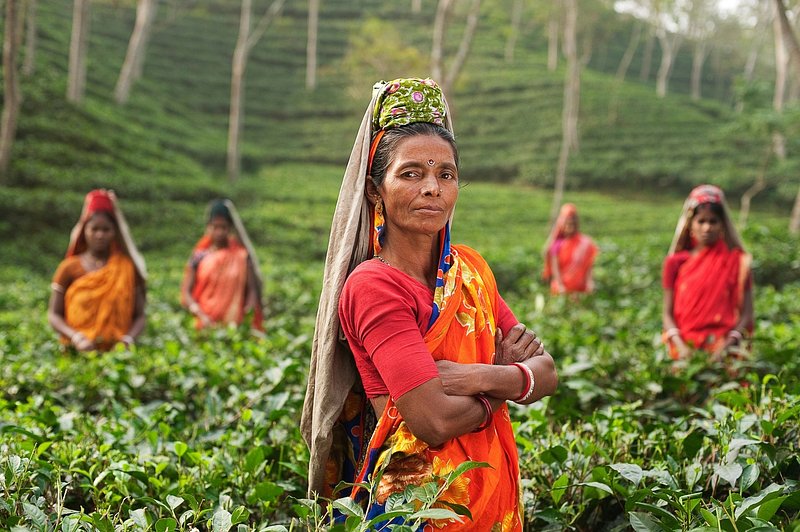
India is the world's second-largest tea producer, just behind China. The country produces more than 1.4 million tonnes of tea per year, representing approximately 20% to 25% of global production. Unlike some other major tea-producing countries, however, India consumes most of its own production. Around 70% to 80% of the tea produced in India is consumed domestically, notably in the form of the very popular chai (sweetened black tea brewed with milk and spices). Some of India's most renowned teas come from the regions of Darjeeling, Assam and the Nilgiris.
India is also where biodynamic farming has expanded significantly since the 1990s, with more than 100,000 producers in the country today. Kerala holds a pioneering and strategic position in India's agricultural transition. This tropical state in southern India is distinguished by a strong political commitment and a particular focus on high-value crops, with the development of biodynamic farming forming part of a government strategy to achieve 100% organic agriculture. A challenge that is still far from being achieved...
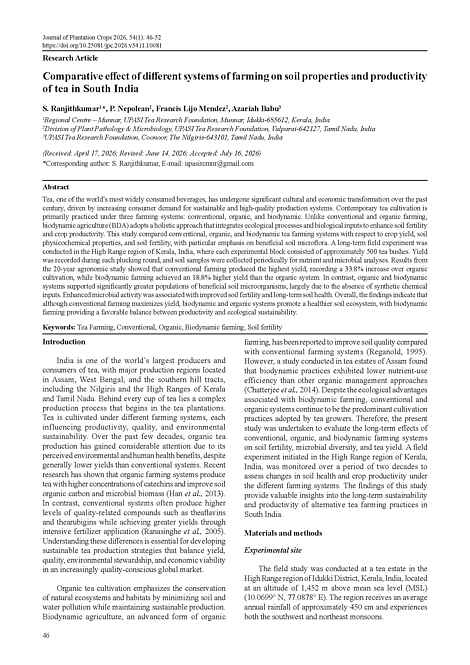
In this state, the UPASI Tea Research Foundation conducted a long-term experiment comparing conventional, organic and biodynamic farming systems. Started in 2002, the results after 20 years of study have recently been published, providing new data on the effects of these different systems on soil microbiome, soil health and yields.
A Long-Term Experiment
The trial was established in 2002 on a tea plantation located in the High Ranges of Idukki District, Kerala, at an altitude of 1,452 metres. Three farming systems were compared: conventional, organic and biodynamic. Each treatment corresponded to a plot of approximately 500 tea bushes, with no replication.
The conventional system involved fertilizers, foliar micronutrients, as well as pesticides, fungicides and herbicides recommended by UPASI. The organic system relied on organic inputs, including 10 tonnes of compost per hectare, as well as various products permitted under organic farming for pest and disease control. The biodynamic system also received 10 tonnes of compost per hectare, supplemented with the biodynamic preparations BD 500, BD 501 and Cow Pat Pit (CPP), applied according to the recommendations of the Bio Dynamic Association of India (BDAI) and in accordance with the biodynamic calendar. Weeding was carried out manually in the organic and biodynamic plots.
The researchers studied three main categories of parameters. Soil fertility and physico-chemical properties were assessed before the experiment began and again after twenty years, using parameters such as pH, organic matter, phosphorus, potassium, calcium and magnesium. Soil microbial communities were monitored annually from 2002 to 2022. Finally, yield was assessed based on the quantity of made tea produced per hectare.
Differing Effects on Soil Fertility and the Soil Microbiome
After twenty years, all three systems had improved several soil fertility parameters, although differences were observed depending on the elements considered. Organic matter had notably increased, as had several mineral elements. The organic system showed the highest levels of organic matter, potassium and calcium, while the biodynamic system had the highest magnesium content.
Differences were also observed in soil microbial communities. While the organic system often showed the highest populations at the beginning of the experiment, the biodynamic system gradually gained an advantage for several microbial groups. In 2022, it had the highest total bacterial population. The authors therefore conclude that organic and biodynamic systems generally favour beneficial microorganisms compared with the conventional system, with particularly persistent effects for certain microbial groups under biodynamic management.
An Intermediate Yield Level for Biodynamic Farming
Across all pruning cycles covering the 2002–2022 period, the conventional system achieved the highest cumulative yield, with 50,746 kg of made tea per hectare. The biodynamic system reached 45,062 kg/ha, 18.83% more than the organic system, which ranked last with 37,922 kg/ha. The differences between the three systems were statistically significant.
The authors attribute the lower productivity of the organic and biodynamic systems in particular to greater weed pressure, as well as slower nutrient release and a higher incidence of certain pests and diseases. By contrast, the synthetic fertilizers used in the conventional system provide readily available nutrients, thereby promoting vegetative growth and production.
At the end of the twenty years of observation, biodynamic farming appears to be a balanced system that produces yields close to those of the conventional system while promoting soil health and long-term sustainability. The lower yields compared with the conventional system are largely offset by the economic value generated by higher-quality products, in line with consumer expectations.
Sources:
Original scientific article: https://updatepublishing.com/journal/index.php/JPC/article/view/10081
Biodynamic farming on the rise in India: https://www.dw.com/en/can-biodynamic-farming-solve-indias-agricultural-woes/a-41498853
UPASI Tea Research Foundation: https://www.upasitearesearch.org/