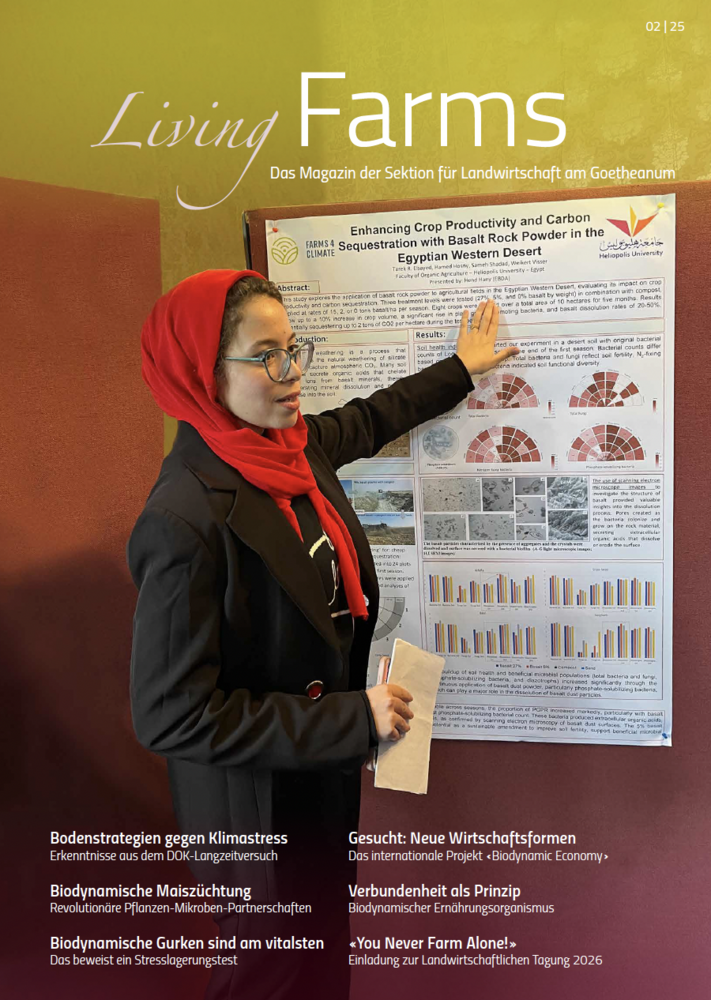
A synthesis of studies presented in ‘Living Farms’, the magazine published by the Section for Agriculture at the Goetheanum, illustrates how biodynamic farming contributes to food quality, animal wellbeing and ecological sustainability.
A stress storage test shows the special quality of biodynamically grown cucumbers: 865 cucumbers from conventional, organic and biodynamic cultivation were sliced, reassembled and wrapped in airtight clingfilm. After two weeks of storage at 23.5 degrees Celsius the regeneration of the cut surfaces was particularly remarkable in biodynamically grown cucumbers since the slices grew firmly together again. Marjolein Doesburg-van Kleffens, one of the project managers and a scientific assistant in Translational Complementary Medicine at Basel University in Switzerland, hypothesizes that “greater microbial diversity or certain beneficial bacteria that enrich the microbiome and make it more diverse are promoted by biodynamic methods.” Further tests are needed to prove this hypothesis.
Cows, with or without horns, are a familiar sight on pastures. But cow horns do not only serve an external purpose. Horned cows that are fed on hay appear to have a slightly higher body temperature and lower heart rate which is indicative of a calmer, more efficient metabolism. In addition, their milk contains more alpha-linolenic acid and fewer short-chain fatty acids – an indication of more balanced metabolic state. Further studies have shown increased inflammation markers in cows without horns on a diet of energy-rich concentrated feed. The results illustrate that horns have a functional importance for animal wellbeing and play an integral part in the cow’s overall organism.
The DOK field trial in Therwil, Switzerland, which has been running for 45 years, illustrates the long-term positive effects of biodynamic farming on soil fertility. Trial manager Hans-Martin Krause points out that 22 years of observation were needed to reveal “significant differences in the organic carbon content of the soil with the same fertilization intensity.” He summarizes the findings of the trial to date: “In biodynamic plots we measure the highest microbial biomass, the highest organic carbon content and greater biodiversity – from soil microbes to the number and diversity of insects.” Living, humus-rich soils, he says, are the foundation of climate protection, plant health and sustainable resilience in farming.
‘Living Farms’ 2/2025 documents how biodynamic research creates the scientific basis for an agriculture that connects ecological, species-appropriate, economic and social requirements.
(2624 characters, 380 words/Anna Storchenegger and Sebastian Jüngel; English by Margot M. Saar)
‘Living Farms’ magazine 2/2025, print and Web
Cucumber study Marjolein Doesburg-van Kleffens, Jens-Otto Andersen, Carsten Gründemann and Jürgen Fritz: Effects of cultivation systems on the antimicrobial, colour retainment and slice healing properties of consumer ready market samples of cucumber (Cucumis sativus L.) Web (2025)
Cow horns 1 (in German) Jenifer Wohlers, Peter Stolz: Milch, Qualität und Hörner. Neue Erkenntnis durch FAS-Messungen, in: Lebendige Erde 4/2022 [German biodynamics magazine] Web
Cow horns 2 Cattle breeding group of the Swiss Biodynamic Association in collaboration with the research institute for organic farming (Forschungsinstitut für biologischen Landbau) Web
DOK field trial Andreas Fliessbach, Hans-Martin Krause, Klaus Jarosch, Jochen Mayer, Astrid Oberson and Paul Mäder: The DOK Trial. A 45-year comparative study of organic and conventional cropping systemsWeb(2024)