It is a scene that can currently be observed in many places: the soil has been scorched by the sun, dried out and hardened like concrete. Then, at last, rain arrives—in the form of a violent summer thunderstorm. The result is unfortunate: much of the long-awaited water is unable to infiltrate the soil and reach the roots. Instead, it runs off across the surface and disappears into the drainage system.
Not so at Katzhof, the farm run by Claudia Meierhans and Markus Schwegler. They demonstrate how a farm can deliberately adapt to prolonged periods of drought and other weather extremes. The couple are taking new approaches to make their Demeter-certified farm in Richenthal, Canton of Lucerne, more resilient. Markus Schwegler explains: “There is no single miracle solution that can bring the impacts of climate change under control. We rely on the interaction of different elements.”
Specifically, their strategy is based on three measures: targeted water management, permaculture and healthy, resilient soil. This holistic approach reflects the principles of biodynamic agriculture, which regards soil fertility and the careful stewardship of natural resources as the foundation of resilient farming over the long term.
Managing and Storing Water
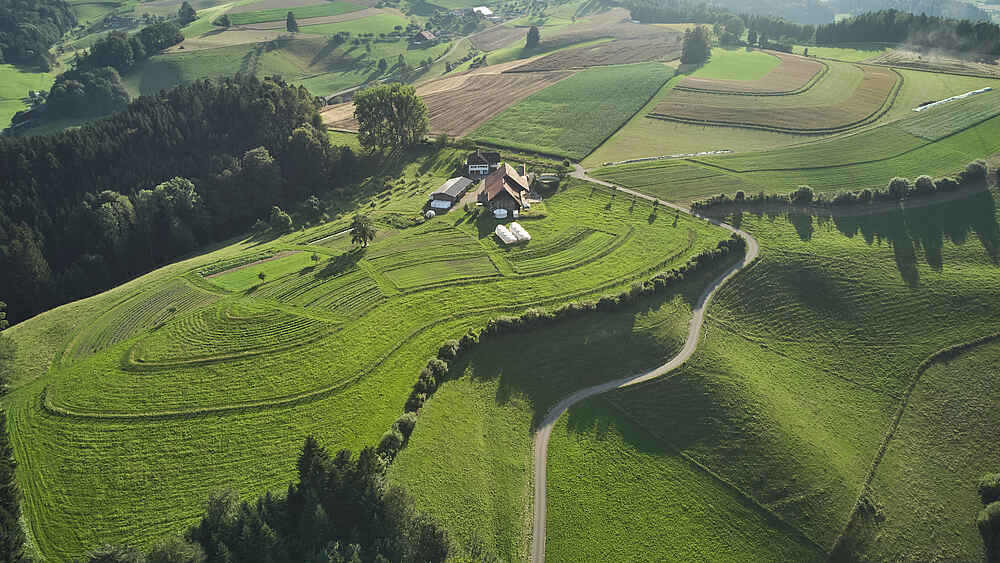
After the farm’s spring produced significantly less water during dry years, Claudia Meierhans and Markus Schwegler completely redesigned their farm’s water management system. At its heart is the Keyline Design system. The concept is elegantly simple: on the higher-lying arable fields, surface water is collected through channels running along the keylines and directed into a storage reservoir. During dry periods, this stored water is available for irrigating vegetable crops.
The vegetable beds are laid out as strips 75 centimetres wide, alternating with permanently vegetated pathways, and follow the Keyline pattern. Water from the reservoir can also be used to irrigate the trees planted as part of an agroforestry system along the water channels. Markus Schwegler sees even greater potential for expansion in this area: “Sufficient water storage capacity is indispensable for our vegetable production. We will invest further in this area over the coming years.”
The exceptionally hot summer of 2026 is providing the first major test of the new system. Markus Schwegler records rainfall at Katzhof with great precision. By the end of July this year, the farm had received 50 per cent less rainfall than the average recorded during the same period over the previous eleven years. His assessment is matter-of-fact: “The extreme drought confirms that we are on the right track. The potential of our measures is becoming very clear at the moment. But even the best water management system is of no use if there is no water. In that respect, we are in the same position as everyone else: we urgently need rain.”
Imitating Nature
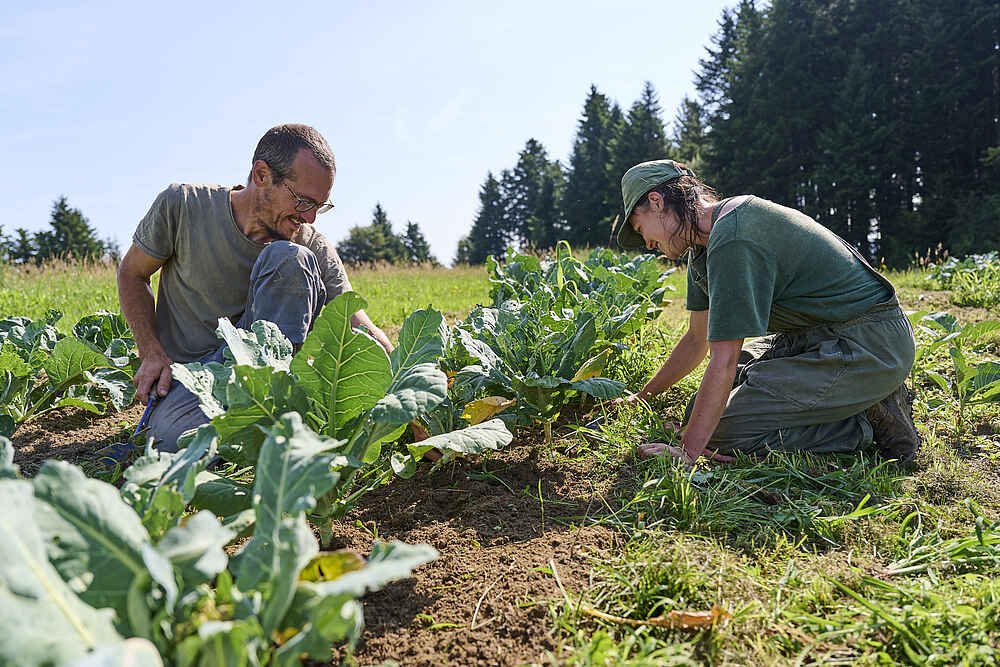
In addition, Claudia Meierhans and Markus Schwegler rely on permaculture. Inspired by natural ecosystems, permaculture aims to make agricultural land more resilient over the long term. It focuses on careful soil management, building up humus and integrating trees, shrubs and diverse mixed cropping systems.
Markus Schwegler has planted chestnut trees and elder shrubs across the arable land. In time, the trees are expected to provide shade and reduce wind speeds, preventing the soil from drying out excessively and being blown away. Markus Schwegler reflects: “Looking back, I think we should have planted the trees much earlier. They are still too small to provide shade and to fully develop their positive effect on the local climate. On the contrary, I have to irrigate them so that they survive the drought.”
Humus Stores Water
Markus Schwegler places particular emphasis on building resilient soil. At Katzhof, the soil is cultivated as gently as possible and remains covered with organic material throughout the year. As a result, the humus content increases, allowing the soil to store more water and retain moisture for longer during dry periods.
Over the coming years, Markus Schwegler also intends to devote even greater attention to the biodynamic horn manure preparation and biodynamic compost management. He is convinced: “Humus is incredibly valuable in situations of this kind, when we are facing extreme conditions.”
Diversity as a Core Value
Summing up, Markus Schwegler says: “Our farm is just as dry as everyone else’s. But when the rain finally comes, we are well prepared to make the best possible use of the water. We achieve this through the interaction of a wide range of measures. For me, diversity is a core value when it comes to resilience: diversity in the soil, in the fields and in our climate adaptation measures.”
Notice
The extreme drought of recent weeks is placing severe stress on plants and animals. Particularly critical is the fact that the grass is barely growing anymore due to the lack of water. As a result, valuable feed is becoming scarce—not only now, but also for the coming winter. The production of hay for winter reserves has largely come to a standstill.
In view of the strained situation, the Demeter Switzerland Guidelines Commission for Crop Production has decided to temporarily increase the permitted proportion of purchased feed.
According to the Demeter Standards, the purchase of organic feed is generally limited to 20% of the total feed quantity. On a temporary basis, up to 40% organic feed may now be purchased, together with an additional allowance of up to 10% conventional feed. The total amount of purchased feed is therefore limited to a maximum of 50% of the total feed quantity.