From 7 to 11 October 2026, we, Ueli and Gaudenz Hurter, met Ernst Götsch, the pioneer of syntropic agriculture, in Sekem, where he was visiting together with his wife. The meeting, partially funded by Hannes Thaler (Forest4Food), brought together people from different countries and professional backgrounds. In addition to representatives of the Sekem initiative—Angela Hofmann, Dr. Sabr, Dr. Amr and Dr. Rehab—Mohammed Imran Bin Hassan and Abdul Azim Bin Che Abdul Rahim from Malaysia also took part at the invitation of Ueli Hurter. On the final day, Fatma Abosamra, Head of the Associated Office of the Section for Agriculture in Egypt, joined the group.
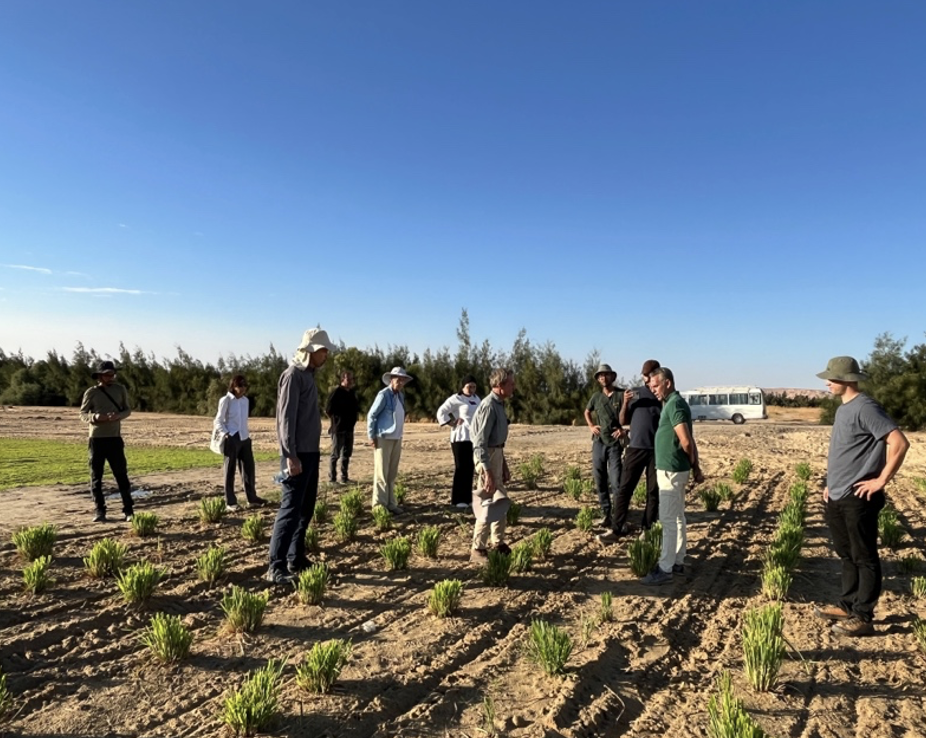
One of the highlights of the meeting was a visit to the Sekem farm in Wahad, an oasis where the initiative cultivates a total area of 1,200 hectares. On 8 October, we explored the experimental fields there. The following day, we set out into the surrounding desert in search of wild-growing plants, initially without success. After inspecting all the pivots, the large-scale irrigation systems, we set off for the main farm on the third day after the morning circle. Along the way, we unexpectedly came across the very plants we had unsuccessfully searched for the day before.
A final debriefing with Helmy Abouleish, CEO of the Sekem initiative, rounded off the exchange before we began our journey back to Switzerland on 11 October. The encounters, observations and conversations formed the basis for the following reflections: we take up the central impulses that Ernst Götsch repeatedly emphasised during the meeting and relate them to our own experiences and our understanding of biodynamics.
How Plants Bring Moisture into the Desert
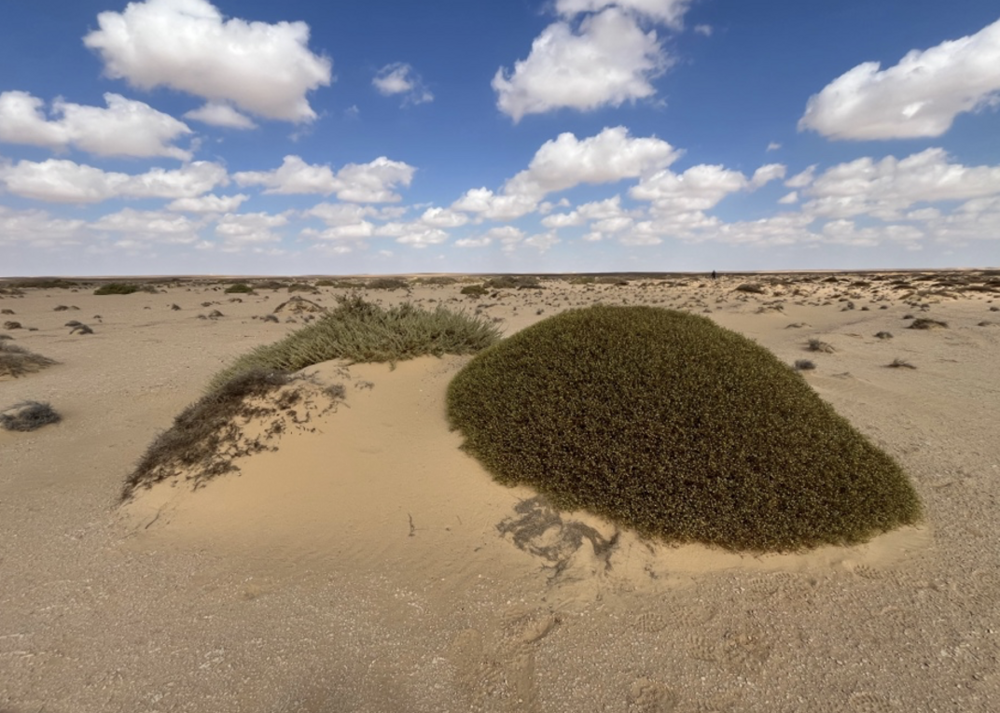
Moisture is present not only in the soil but also in the atmosphere. Plants can help make use of this moisture and bring water into dry landscapes. One example can be found in the desert: halophytes, or salt-tolerant plants belonging to the Chenopodiaceae group, establish themselves on small sand mounds. They can attract moisture with the help of salt. As they grow, they cool the soil beneath them, allowing water from the atmosphere to condense.
In this way, they create the conditions for the next plant species, Artemisia judaica. It no longer needs salt to become established. Through the local cooling of the soil, moisture can once again condense out of the atmosphere. Step by step, an environment with lower salt levels develops, allowing further plants to establish themselves. Once the soil is largely covered with vegetation, the conditions are in place for planting trees.
Analogies with Biodynamic Agriculture
A balanced farm organism alternates between two states: inhalation and exhalation, which Ernst Götsch describes in terms of the two directions of movement of a vortex.
A similar vortex movement also occurs when stirring biodynamic preparations. In this process, the water is stirred from the outside towards the inside, that is, towards the centre. According to the biodynamic understanding, the horn manure preparation promotes plant development through the soil and moisture. It is applied in the evening and is associated with the inhalation of the Earth and a downward movement. The horn silica preparation, by contrast, supports the effects of sunlight, particularly photosynthesis and the ripening of plants. It is applied in the morning and symbolically represents the exhalation of the Earth and an upward movement.
Biodynamic preparations enable human beings to participate consciously and creatively in these processes and to guide the interplay of soil, plants and atmosphere in a deliberate way.
Establishing Trees in the Desert—Working with Nature
How can trees be established in the desert without relying on permanent irrigation? Ernst Götsch relies on natural succession. Rather than changing the landscape in opposition to its conditions, human beings actively participate in shaping natural developmental processes and create habitats for more demanding plants step by step.
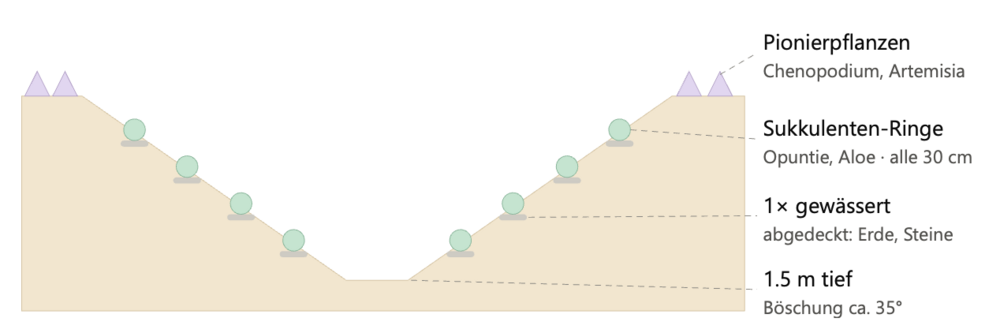
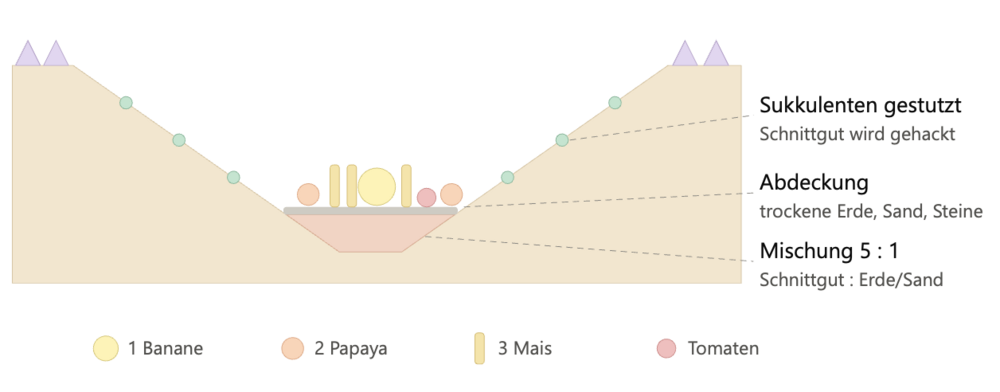
In Wahad, this process begins with a funnel-shaped depression in the ground, approximately 1.5 metres deep. Drought-tolerant succulents, such as prickly pear cactus or Aloe vera, are planted along its sloping sides. They require very little water and are intended to establish themselves as independently as possible after an initial watering. To prevent the water from evaporating too quickly, the watered area is covered with dry soil, sand or stones. The succulents are arranged in circular rows, with a distance of approximately 30 centimetres between them.
Desert pioneer plants are added around the depression. They are intended to help green the surrounding area gradually and promote the “inhaling vortex” described by Götsch.
From the Succulent Ring to the Tree
After approximately six months, the succulents should have become established. They are then cut back, and the cuttings are chopped into small pieces and mixed with soil and/or sand in the lower part of the depression. Götsch specifies a mixing ratio of five litres of plant residues to one litre of soil and/or sand. One banana plant, two papaya plants, three maize plants and tomato plants are sown in this mixture. It is important to cover the mixture again with a layer of dry soil, sand and stones to limit evaporation.
Once the maize and tomatoes have completed their growth cycle, they are cut back, as are the succulents. The plant material is chopped into small pieces again and mixed with soil. In this way, a small mound gradually forms in the centre of the depression, where a tree, such as a citrus tree, can eventually be planted.
Planning: Thinking in Terms of Plant Interactions
The starting point is the choice of the main crop. If, for example, we decide to grow coffee, its requirements determine the planting distances and the selection of companion plants. We begin by asking fundamental questions: What nourishes the coffee plant? What protects it? How much water does it need? And which plants can support its development? Companion crops are selected to fulfil these functions and complement one another.
Two principles are particularly important: stratification and succession. Stratification describes how plants occupy different vertical layers of space, from ground cover to the upper tree canopy. Ernst Götsch recommends taking at least four, and preferably five, such layers into account. Succession refers to the natural sequence over time in which plants become established, develop and are replaced by other species. Equally important is maintaining as continuous a ground cover as possible, which protects the soil and helps retain its moisture.
The planning phase is also an opportunity to produce or procure the required planting material. At the same time, the area can be prepared: pioneer plants can cover the soil and produce large quantities of biomass. Grasses are particularly suitable for this purpose. Their plant material is later returned to the system through cutting, where it serves as mulch and organic matter.
Management: Cutting, Guiding and Encouraging Growth
The key intervention in a syntropic planting system is the targeted pruning of plants. Cutting does not merely change the availability of light; it also influences the growth of the entire plant community. Götsch emphasises that pruning can stimulate growth processes that also affect neighbouring plants. The strength of these effects depends, among other factors, on the plant species and the site conditions.
Three basic pruning techniques are used:
Coppicing: The plant is cut back close to the ground. In suitable species, this allows new shoots to emerge from the stump.
Pollarding: The crown is cut back at a particular height on the main trunk. This makes it possible to limit the height of a tree and prevent it from growing over other plants.
Lopping: Individual branches are removed to alter the structure of the crown and allow more light to reach the plant layers below.
These interventions make it possible to regulate light and shade deliberately and encourage the plants that currently need more space. As much of the cut material as possible remains on the site: it is chopped into small pieces and distributed as mulch. Plant material used as animal feed can return to the cycle through the animals’ manure. Wood required for heating or construction, by contrast, is removed from the system.
Through natural succession, the plant community changes continuously. Some species disappear while others become established. Management must take this development into account and adapt repeatedly to the changing conditions.
This requires a watchful eye and experience. Human beings must learn to recognise what the entire system and each individual plant currently need. Sometimes a light pruning is sufficient; in other cases, a more drastic intervention, such as removing the entire crown, may be appropriate. The key is not to carry out interventions according to a rigid scheme but to adapt them to the situation at hand.
Compost: The Interplay of Fungi and Bacteria
For Ernst Götsch, fungi play a particularly important role in compost. During a conversation with Ueli Hurter, the question arose as to whether, in anthroposophical terms, bacteria might be associated more with astrality and fungi with the etheric realm.
Götsch argued that compost should be more strongly dominated by fungi. He considered basidiomycetes particularly important. These form a large group of fungi that includes, for example, many mushrooms with caps. His ideas about nitrogen fixation and the role of these fungi in compost provide a starting point for investigating their actual functions and their interactions with bacteria in greater detail.
Ernst Götsch also proposes creating a depression in the middle of the compost heap so that its cross-section resembles a camel’s hump. He relates this shape to an inhaling vortex. A similar idea can be found in the fourth lecture of Rudolf Steiner’s Agriculture Course, which addresses the shaping of the manure heap.
Questions for Further Investigation
The conversations with Ernst Götsch have raised topics that we would like to pursue further in our research project “Biodynamics meets Agroforestry”.
- Reconsidering the compost preparations: What influence do biodynamic compost preparations have on processes between plants? Ueli Hurter suspects that, among other things, they may affect interactions such as the regulation of growth. This hypothesis requires further investigation.
- Understanding fungi and bacteria better: What roles do these two groups of organisms play in the soil and in compost? How do they influence one another, and what balance is beneficial under different conditions? Hannes Thaler argues that a higher proportion of fungi is advantageous. Whether this is the case, however, depends on the respective site conditions and the functions intended for the compost.
These questions demonstrate how the experiences of syntropic agriculture can be connected with biodynamic approaches. They invite us to combine practical observations with scientific findings and to continue investigating the relationships between plants, soil organisms and agricultural management.