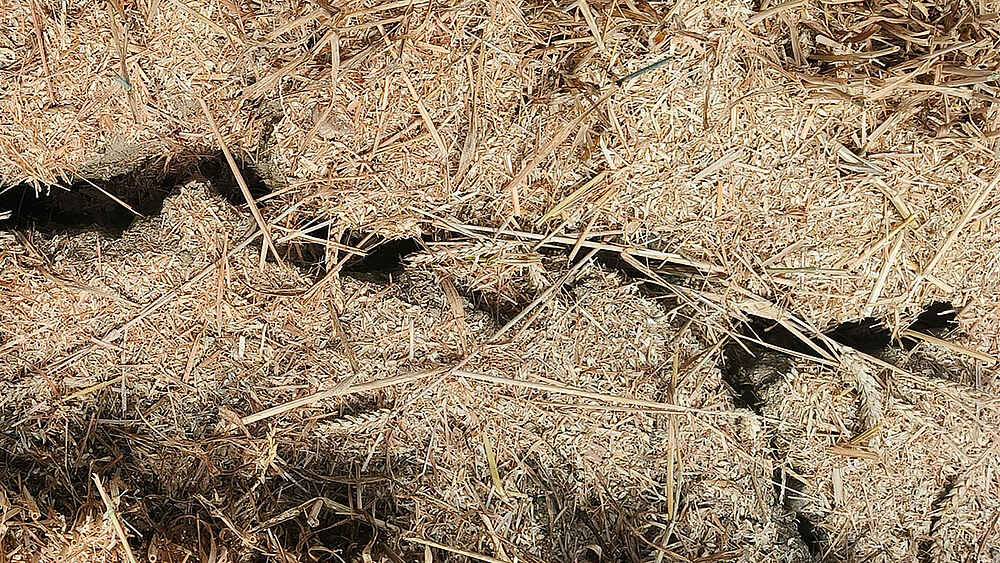
Farming around the world is under pressure due to drought. Heatwaves and the absence of rainfall cause dried out soils and threaten to spoil crops. While biodynamic farming cannot change the broader conditions in the short term, it does have experience with shading and with building up humus to store water and increase plant and animal resilience.
“We know from experience and scientific research that agroecology, organic farming and biodynamics can help mitigate the effects of extreme weather,” says Martin Quantin, research associate in the Section for Agriculture at the Goetheanum, Switzerland. The agricultural engineer quotes the diversification of agricultural systems as fundamental, referring in particular to the combination of, for example, field crops, livestock, arboriculture, vegetable farming and fruit growing, as well as semi-natural areas such as hedgerows, meadows, ponds and copses. Martin Quantin uses the example of trees to illustrate this: “Trees provide shade for sensitive crops and livestock whilst limiting the drying effects of the wind. Root systems explore different depths of the soil, improving its water retention and stability.”
He mentions the soil as a second key to resilience. “Promoting the forming of humus supports the formation of erosion-resistant aggregates whilst creating a porous network capable of efficiently storing and redistributing water throughout the soil. Additionally, fertile, active humus develops most effectively in living soils that are rich in microorganisms.” Scientific studies have shown that biodynamic farming enhances soil resilience and vitality, particularly during difficult years, and therefore creates the foundation for resilient crops.
Katzhof, a biodynamic farm in the Swiss Canton of Lucerne, is a good example because their approach is to store water, promote diversity and living soils and channel rain water into a storage reservoir, using it for irrigating vegetable crops during dry periods. Farm manager Markus Schwegler has had good results with this approach, but he also points out that “even the best water management system is of no use if there is no water. We urgently need rain.”
The Section for Agriculture at the Goetheanum is currently preparing a project called ‘Biodynamics meets Agroforestry’ which, by 2030, will assess how biodynamic arboriculture contributes to climate resilience, soil fertility, biodiversity, food security, income and quality of life in subsistence smallholdings. The project will start with partner institutions in Egypt and Kenya and is co-led by PhD student Fatma Abosamra (supervisor for Egypt) and Gaudenz Hurter (supervisor for Kenya and other partners in Africa and Europe).
Martin Quantin points out that the responsibility for this transition cannot be left to farmers alone: “Researchers, educators, consumers, politicians, businesses and society as a whole have a role to play in contributing to the development of a resilient agroecology that will allow us to eat healthily even under uncertain conditions.”
(English by Margot M. Saar)
Overview of studies Martin Quantin: Climate-resilient agriculture. How can resilient agricultural systems be achieved? Web
About the Katzhof, Canton of Lucerne, Switzerland Patrick Schellenberg: Innovation against severe drought Web