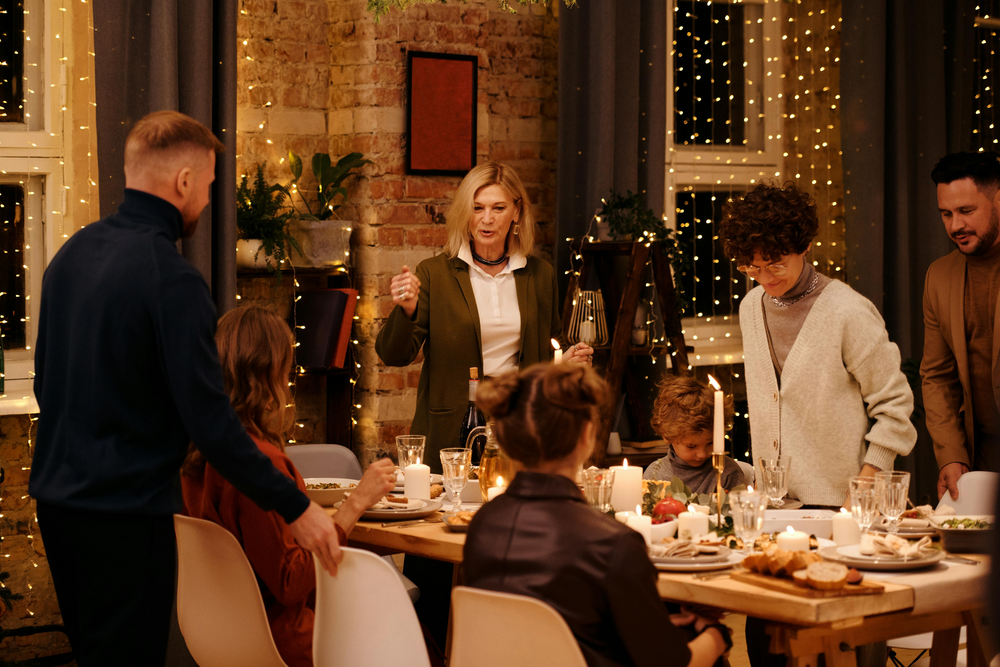
Christmas dinner with the in-laws affects the gut microbiome. This was investigated by a research group. Surprisingly, they found that spending time with the in-laws has a short-term effect on the gut – in a way that is otherwise observed in cases of psychological stress and depressive moods. This means that, in addition to food choices, the atmosphere and environment also have a significant influence on the gut microbiome. This is one more reason to focus not only on the upcoming festive meal, but also on harmonious togetherness – as a way of caring for physical and mental health.
Christmas is just around the corner – a festival that is of great importance in the Christian world as a family celebration and is celebrated accordingly. It is an occasion to spend time with family, in-laws and relatives. Hardly any other festive season of the year is associated with so many expectations and preparations, which can also be perceived as stressful.
It is well known that certain compositions of gut bacteria are associated with certain clinical pictures. For example, people with depression have more pro-inflammatory bacteria and less bacterial diversity compared to healthy people. The gut microbiome is influenced not only by diet but also by psychological factors – especially stress. Even short-term stressful situations can lead to changes.
A group of researchers investigated the extent to which Christmas dinner with the in-laws influences the gut microbiome. To do this, they analysed the gut bacteria of 24 normal-weight subjects between the ages of 20 and 40. These were divided into two groups: one spent Christmas with their in-laws, the other with their own family. On 23 and 27 December 2019, all participants provided a stool sample for bacterial analysis.
Seven bacterial species were identified whose relative change differed significantly. Participants who visited their in-laws showed a significant decline in all Ruminococcus species – a pattern also observed in psychological stress and depression. At the same time, the group that spent Christmas with their own family showed greater bacterial diversity.
Discussion
The significant results of this study highlight how important atmosphere, relaxed interaction and physical contact are for health. The atmosphere is probably more relaxed within one's own family, and physical contact occurs more frequently – for example, through a hug or a kiss. This was probably not the case for the group visiting their parents-in-law. This could explain the differences in gut bacteria. Social and physical contact promotes both the number of microorganisms and microbial diversity, thereby contributing to well-being. Nevertheless, the study would need to be repeated with a larger number of participants, identical meals and a recording of stress levels and behaviour in order to confirm the results and make generally valid statements.
What is certain is that the gut microbiome is an important foundation for our health: the number and composition of microorganisms reflect both our eating habits and our lifestyle. It is not only what we eat that is important, but also how we eat. In addition to fresh foods with few highly processed ingredients, a relaxed atmosphere and stimulating social contact also contribute to maintaining a diverse, balanced microbiome and thus to our physical and mental health. At Christmas in particular, it is therefore worth paying attention not only to the festive meal, but also to harmonious togetherness.
Merry Christmas!
Bibliography
[1] de Clercq NC, Frissen M N, Levin E, Davids M, Hartman J, Prodan A, Herrema H, Groen A K, Romijn J A, Nieuwdorp M (2019): "The effect of having Christmas dinner with in-laws on gut microbiota composition" Human Microbiome Journal (13), 100058, https://doi.org/10.1016/j.humic.2019.100058.