Combining soil health and crop yield. Is that possible? The team of researchers led by Felix Milke wants to get to the bottom of this and other questions. In their 2024 study, they are looking at the effect of biodynamic preparations on soil organisms, which in turn influence the growth of plants. The hypothesis is being tested as to whether the biodynamic preparations inoculate the soil with ‘Plant Growth Promoting Microorganisms’ (PGPM). The results were compared with organic farming methods.
Who is actually fertilising whom?
Creado por Lukas Maschek | | SLW News

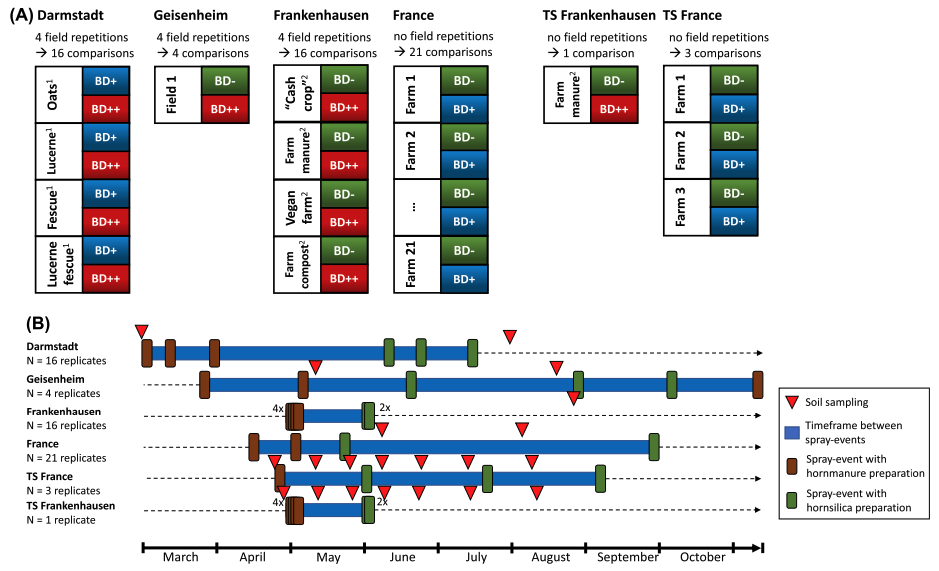
Figure 1: A total of 254 soil samples and 20 samples of biodynamic preparations were genetically analysed for this study. The soil samples come from 3 test plots in Germany and 21 farms in France and cover different cultivation systems, soil types and climatic conditions.
Microbial soil community
If you are interested in plants, you can't avoid looking at the soil from which they grow. The soil harbours a wealth of microorganisms, bacteria and fungi: the soil microbial community. It has long been recognised that this influences plant growth. Now it has been investigated in more detail how the biodynamic preparations affect the soil microbial community and thus plant growth.
Biodynamic preparations
In conventional farming systems, the microbial soil community is often impaired by the intensive use of pesticides and synthetic fertilisers. Other systems such as biodynamic agriculture and organic farming take the path of sustainability. They try to strengthen the existing soil life and limit fertilisers and pest control measures to a minimum. Biodynamic preparations go one step further. They have a direct influence on the microbial soil community - according to the researchers' hypothesis.
Biofertiliser
Biodynamic preparations contain a variety of microorganisms, so-called ‘plant growth-promoting microorganisms’ (PGPM). These can produce substances that benefit plant growth and reduce the effects of stress factors. They are therefore a good biofertiliser for the soil. Biofertiliser here does not mean fertiliser from biological sources, but actual living fertiliser in the form of microorganisms that colonise the soil and become part of the microbial soil community.
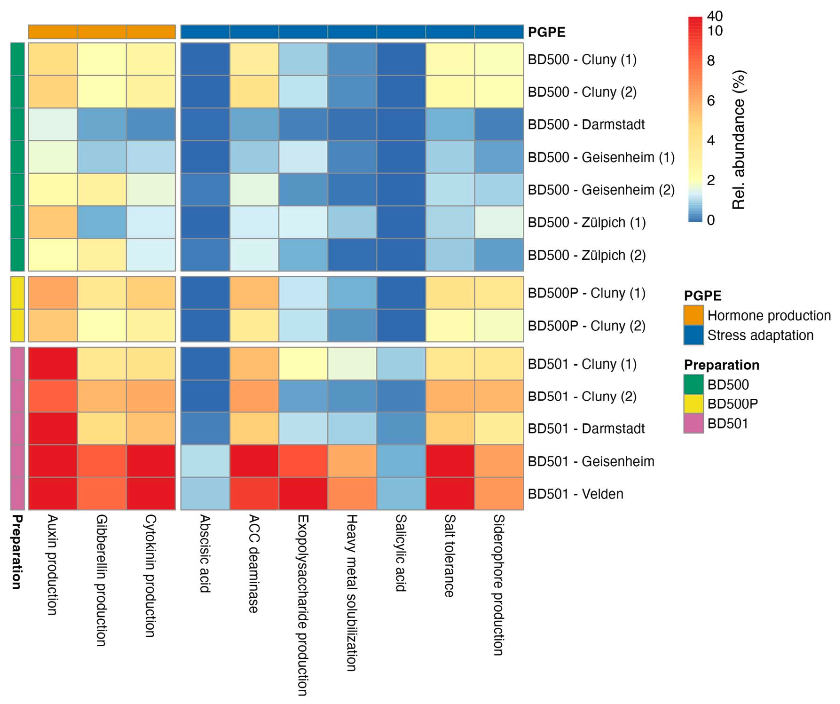
Figure 2: The genetic analysis of the biodynamic preparations shows that they contain many PGPMs that are associated with hormone production and stress adaptation. These values are particularly high in the horn silica preparation (BD501). PGPE: Plant growth promoting effects.
The results of the study can be summarised as follows:
- The biodynamic preparations contain high levels of PGPMs (Fig. 2).
- The application of the biodynamic preparations significantly increased the levels of PGPMs in the soil (Fig. 3).
- A time series was also carried out for the hypothesis of inoculation. This coincides with the typical course of an inoculation.
- Bacteria and fungi that occur frequently in the preparations are also found in significantly higher numbers in the soil after the preparations have been applied.
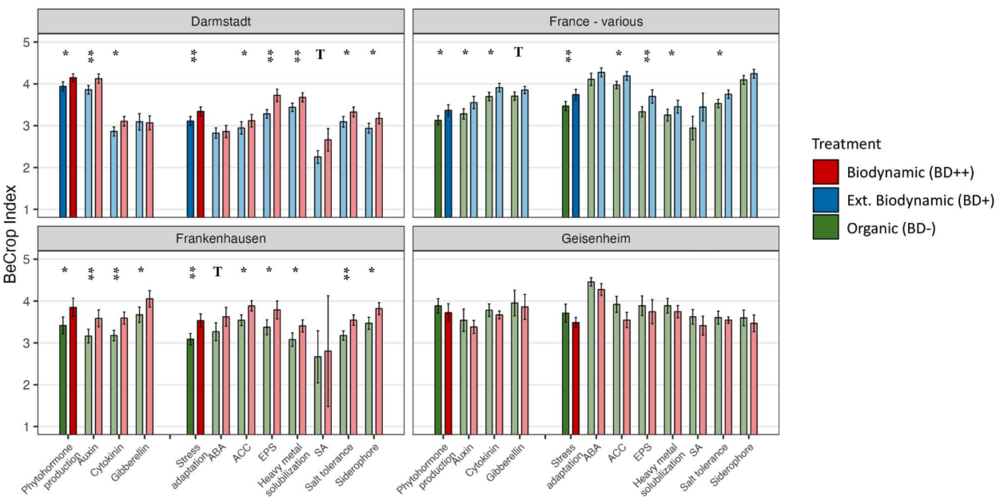
Figure 3: Overview of possible growth-promoting substances and functions, broken down by location and agricultural system. BD++: 3 treatments each with BD500 and BD501. BD+: One treatment each with BD500 and BD501. BD-: Organically farmed soils without preparation application as control areas.
Conclusion
The researchers conclude that biodynamic preparations influence the composition of the soil microbial community. In addition, the microorganisms contained in the preparations can help to improve plant growth and adaptation to stress factors. The effect of biodynamic preparations was most evident under unfavourable growing conditions (e.g. little fertiliser, drought stress).
Sources and further links to this article
- Original study: Milke, F., Rodas-Gaitan, H., Meissner, G., Masson, V., Oltmanns, M., Möller, M., Wohlfahrt, Y., Kulig, B., Acedo, A., Athmann, M., Fritz, J. Enrichment of putative plant growth promoting microorganisms in biodynamic compared with organic agriculture soils. ISME Communications, Volume 4, Issue 1, January 2024,ycae021, https://doi.org/10.1093/ismeco/ycae021