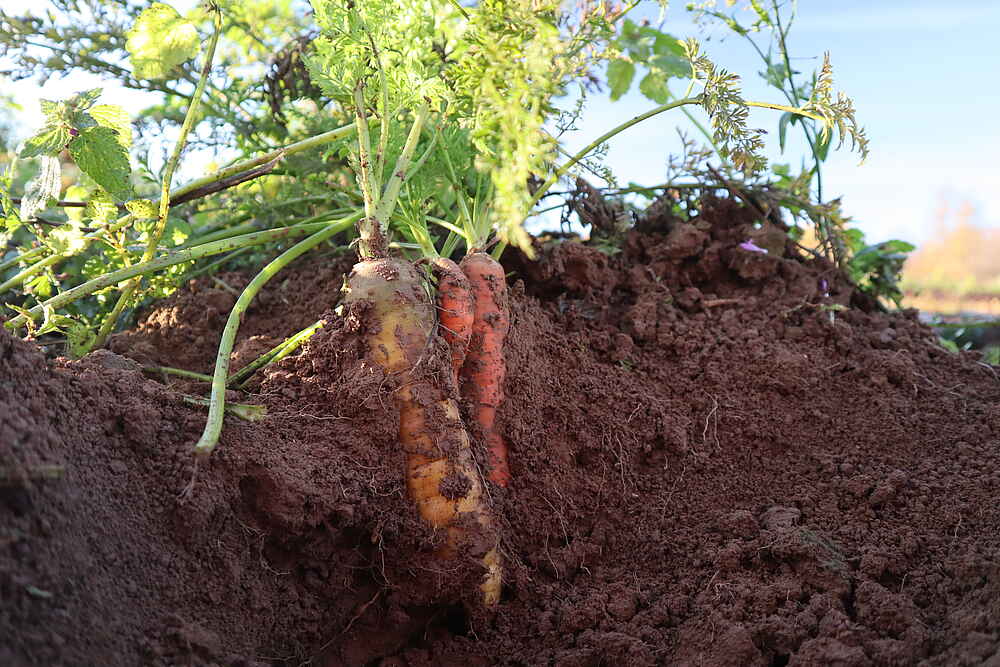
Soil microorganisms account for at least a quarter of the earth’s total biodiversity and thus represent a vast ‘microbial reservoir’. From there, many microorganisms enter the roots, leaves, fruits and seeds of plants, forming the plant microbiome. The composition of the human gut microbiome, in turn, depends heavily on the environment, diet and lifestyle. People who eat plenty of fibre, live in rural areas or have frequent contact with nature, and are rarely stressed, have a different gut microbiota to those who follow a low-fibre diet and/or live in urban environments. There is some evidence to suggest that these external influences are stronger than internal factors such as human genetics. This has led to the hypothesis that the microbiota of soil and plants are among the most significant factors influencing the diversity of the human microbiota, and that all three components together form the so-called soil-plant-gut axis. It is assumed that the composition of the human gut microbiome is constantly influenced by microbes that enter the body via plant-based foods and the environment.
In the review by Ma et al. (2025), microbes are classified into so-called ‘specialists’ and ‘generalists’ [1]. ‘Specialists’ are defined as all microbes that occur almost exclusively in a specific habitat – for example, only in the soil or only in the gut. ‘Generalists’, on the other hand, are microbes that can be found in soil, plants and the gut. These possess certain characteristics that enable them to adapt to their respective environments. They are therefore of interest for understanding the microbial connections between the kingdoms of nature. One well-known example is the genus Clostridium ssp. In the soil and in plants, for instance, they can fix nitrogen and solubilise phosphates, which is important for healthy plant growth. In the human gut, however, Clostridium bacteria ferment carbohydrates and produce short-chain fatty acids that promote gut health. Lactobacillus bacteria have equally positive effects on plants as they do in the human gut, by stimulating growth and breaking down heavy metals in the soil. Conversely, however, the same applies to pathogenic bacteria: Salmonella not only causes illness in humans but can also colonise plants, weakening their immune systems and thereby causing chlorosis – a reduction in chlorophyll production – as well as leaf wilting.
Microbes use a wide variety of methods to work together: for example, they can produce molecules that affect two different living organisms, such as plants and humans, by binding to both plant and human receptors that are compatible with them, provided the receptors have similar structures. This enables the microbes to trigger immune or stress responses in both plants and humans, amongst other things. Another form of interaction is known as ‘horizontal gene transfer’. In this process, microbes within a habitat exchange genes with one another, such as antibiotic resistance genes. A concrete example of this is a study that examined pig farms and their surroundings [2]. Many antibiotic resistance genes were detected in the environment. These genes were not only spread via aerosols – droplets, particles from barn air and manure – but were also passed on between microbes, thus entering the environment and the human gut.
Another way in which microbes work together is by displacing or blocking new microbes, a process known as ‘colonisationresistance’ [1]. In this way, a healthy gut microbiome protects itself against pathogens. Microbes can also help one another by exchanging metabolic products. For instance, soil microbes produce vitamins such as vitamin B12, which can indirectly benefit the gut microbiome as well. As humans do not normally ingest soil microbes directly into the gut, plant microbes act as intermediaries. Via plant-based foods with their specific microbial communities, such substances enter the human gut, where they are further processed by the gut microbiota. This clearly demonstrates that soil, plants and the human gut microbiome are interconnected, even without the microorganisms themselves being directly transferred. Above all, it shows that the microbiomes of soil, plants and humans are closely linked. It can therefore be said that health is also mutually influenced, meaning that there is only One Health. Bearing in mind that biodynamic soils have a richer microbiome than organically farmed soils [3], it can be concluded, in the context of the review article, that biodynamic agriculture makes a significant contribution to the health of the soil, plants and, ultimately, humans.
The next article will use further studies to explain how this interplay affects us humans in our daily lives.
References
[1] Ma H, Cornadó D & Raaijmakers JM (2025): ‘The soil-plant-human gut microbiome axis into perspective’. Nat Commun 16, 7748. https://doi.org/10.1038/s41467-025-62989-z
[2] Song L, Wang C, Jiang G, Ma J, Li Y, Chen H & Guo J (2021): ‘Bioaerosol is an important transmission route of antibiotic resistance genes in pig farms’. Environment International 154, 106559. https://doi.org/10.1016/j.envint.2021.106559
[3] Milke F, Rodas-Gaitan H, Meissner G, Masson V, Oltmanns M, Möller M, Wohlfahrt Y, Kulig B, Acedo A, Athmann M & Fritz J (2024): ‘Enrichment of putative plant growth-promoting microorganisms in biodynamic compared with organic agriculture soils’. ISME Communications 4(1), ycae021. https://doi.org/10.1093/ismeco/ycae021